
The Tax Consequences of a Forced Liquidation for Japanese Crypto Traders

 Prefer us on Google


One of the most common — and most anxious — questions when an exchange winds down is: "If the exchange force-closes my position, do I still owe tax on it? I didn't choose to sell." Under current Japanese rules, the answer is generally yes. A close is a realization event regardless of who pressed the button. This page explains, factually, how a forced liquidation is taxed in Japan, how losses are treated, and how the enacted-but-future 2028 reform does and does not change the picture. It is general information about the rules, not tax advice — see the note at the end.
The core rule: closing a position realizes a taxable gain or loss
In Japan, profit from crypto-assets (暗号資産, commonly 仮想通貨) is generally classified as miscellaneous income (雑所得) and taxed under comprehensive taxation (総合課税) — meaning it is added to your other income (such as salary) and taxed at progressive rates. The National Tax Agency (NTA) states that profit arising from selling or using crypto-assets is, in principle, classified as miscellaneous income requiring an income-tax return.
A gain is realized at the point of disposal — a sale, a use (spending), or an exchange into another crypto-asset — and, for a leveraged position, at the point the position is settled (closed). Crucially, the rule does not distinguish between a close you initiate and a close the exchange executes for you. A forced liquidation is still a disposal. The moment an open derivative position is closed at market on the deadline, the profit or loss on that position becomes a realized figure for the tax year in which it closes.
So for a position force-closed on July 22, 2026, the realized gain or loss lands in the 2026 tax year (令和8年分), and is reported in the tax return filed in spring 2027 (the filing window runs roughly February 16 to March 15, 2027).
How much tax? Comprehensive taxation, up to about 55%
Because crypto gains are taxed comprehensively, there is no single flat rate. The gain is stacked on top of your other income, and the combined marginal rate can reach roughly 55% at the top — up to 45% national income tax on the highest bracket plus 10% local (resident) tax, with a 2.1% reconstruction surtax applied to the national portion. For most people the marginal rate is lower; the point is that a large realized crypto gain can be taxed at a high rate precisely because it is aggregated with everything else.
A note that trips people up: crypto margin and derivative gains are taxed the same way — as miscellaneous income under comprehensive taxation. They are not eligible for the flat ~20.315% separate taxation that applies to retail FX. Leverage does not change the category for crypto.
How losses are treated (current law)
Losses have limited usefulness under the current regime, which matters when a forced close crystallizes a loss:
- Same-year offset within miscellaneous income: a crypto loss can offset crypto (and other miscellaneous-income) gains realized in the same calendar year.
- No carryforward: a net crypto loss for the year cannot be carried forward to reduce future years' income.
- No cross-category offset: a crypto loss cannot be used against your salary or other income categories.
In other words, if a forced liquidation closes a losing position, that loss can only help you against other crypto/miscellaneous gains you realized in 2026 — it does not travel into 2027 and does not reduce your salary tax.
A simple worked example
These numbers are illustrative only — a made-up scenario to show the mechanics, not a real case or a calculation of anyone's liability.
Scenario A — a net gain year.
- Earlier in 2026 you closed a trade at a loss of ¥300,000.
- On July 22, 2026, a leveraged long is force-closed with a realized profit of ¥800,000.
- Within the same year these offset: ¥800,000 − ¥300,000 = ¥500,000 net crypto miscellaneous income for 2026.
- That ¥500,000 is added to your other income (e.g., salary) under comprehensive taxation and taxed at your applicable progressive rate. You report it in the 2026 return filed by mid-March 2027.
Scenario B — a net loss year.
- Suppose instead your 2026 crypto activity nets to a loss of ¥200,000 after the forced close.
- Under current law that ¥200,000 loss cannot offset your salary and cannot be carried into 2027. Its only use would have been against other 2026 crypto/miscellaneous gains, of which there are none here.
The takeaway: a forced close is a taxable event that lands in the year it happens, and a loss from it has narrow usefulness under today's rules.
What the 2028 reform changes — and what it does not
Japan's FY2026 tax-reform outline (令和8年度税制改正大綱, published December 2025) proposes moving certain "specified" crypto-assets to separate self-assessment taxation (申告分離課税) at a flat 20.315%, with a proposed three-year loss carryforward. Two limits matter for anyone reading this because of the Bybit wind-down:
- Timing: it is proposed to take effect around January 1, 2028 (令和10年), and depends on amendments to the Financial Instruments and Exchange Act passing the Diet. It does not apply to a 2026 event.
- Scope: as proposed, the flat 20.315% regime covers transactions on domestic, registered venues. Transactions on offshore or unregistered venues are expected to remain under comprehensive taxation (総合課税).
Because a Bybit forced close on July 22, 2026 is both (a) in 2026 and (b) on an offshore venue, it falls squarely under the current miscellaneous-income / comprehensive-taxation rules described above — the reform's flat rate does not reach it, on either count. Treat the reform's exact rate, effective date, and carryforward term as "as proposed / pending legislation" until it is finalized.
Practical points to keep records of
- The date and value of each close, including any forced close — the exchange's transaction history is the source.
- Your cost basis and the realized profit or loss per position.
- All 2026 crypto disposals together, since same-year offsetting is calculated across them.
Primary sources
- National Tax Agency (NTA) — crypto-asset taxation as miscellaneous income (Tax Answer No.1524; the NTA FAQ "Tax treatment of crypto-assets")
- NTA — income-tax rates (Tax Answer No.2260) and the annual final-return filing period
- FY2026 tax-reform outline (令和8年度税制改正大綱) — separate-taxation proposal for specified crypto-assets (pending legislation)
- Bybit official announcement — "Service Changes for Japanese Residents" (the July 22, 2026 forced-liquidation date)
This page explains the general rules; it is not tax advice. Individual circumstances change the result, and the rules can be updated. For your own situation — especially anything involving a large realized gain or loss — consult a qualified tax professional (税理士) or the National Tax Agency.
Disclaimer: This content is provided for general branding and informational purposes only and doesn't constitute financial, investment, legal, or tax advice. Any events, rewards, online events, or related information mentioned herein should not be considered a recommendation, solicitation, or invitation to purchase, sell, trade, or otherwise deal in any crypto assets or to use any services. Crypto assets are highly volatile and may result in loss. WEEX services and online events may not be available in all regions and are subject to applicable laws, regulations, and eligibility requirements. You are responsible for ensuring that your use of WEEX services complies with local laws and for carefully assessing the risks before participating in any crypto-related activities.
You may also like

How to Import Your WEEX Trade History into Cryptact (for Japan Crypto Tax Filing)

Best Crypto Apps and How to Choose One (2026)
How to Get Started with Crypto: From Account to First Purchase (2026)
How to Buy Bitcoin (BTC): A Beginner's Step-by-Step Guide (2026)
How to Buy Crypto in Indonesia for Beginners (2026): Register, Deposit, and Buy Bitcoin
Best Crypto Trading App & APK in Indonesia (2026): Features, How to Download Safely, and What to Check
Crypto Exchange Comparison for Germany (2026): Fees, Products, and How to Choose

Crypto Apps Compared for Germany (2026): Features, Demo Mode and Security — What to Check Before You Download
Crypto Platform Comparison for France (2026): Fees, Products, and How to Choose
Crypto Apps Compared for France (2026): Features, Demo Mode and Security — What to Check Before You Download
NVIDIA (NVDA) Earnings Date: When Q2 FY2027 Reports and What to Watch
Is WEEX Safe? A Facts-First Look at WEEX's Reserves, Security, and Regulatory Status in Japan

When an Overseas Exchange Ends Its Japan Service: The Typical Sequence and What Users Should Check
Bybit Japan Service Termination: The Complete Timeline and What Happens on July 22, 2026
How to Withdraw From Bybit After the Japan Service Shutdown: Step-by-Step and a Deadline Checklist
After Bybit's Japan Shutdown: A Neutral Map of Where Your Funds Can Go
Gold Price Outlook 2026: Third-Party Analyst Scenarios (Maintained, Educational)
Silver Price Outlook 2026: Third-Party Analyst Scenarios (Maintained, Educational)
How to Buy Bitcoin in Brazil: A Step by Step Guide for Beginners
Dolar Crypto in Argentina: How to Use Stablecoins for Dollar Exposure and Buy Bitcoin
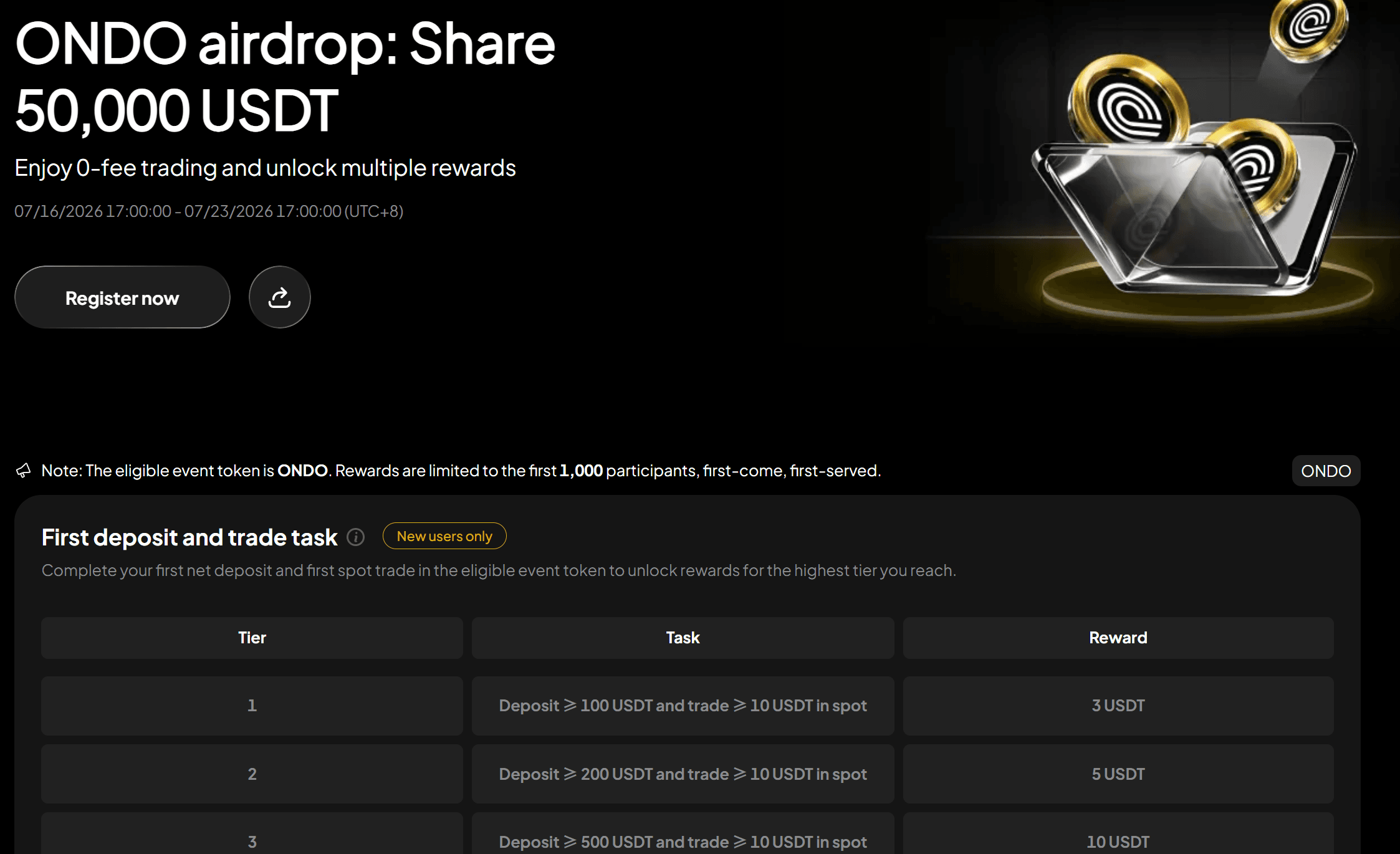
Claim ONDO Airdrop Rewards: Complete Tasks and Share 50,000 USDT
Claim ONDO Airdrop rewards on WEEX and share 50,000 USDT. Learn how to join, complete trading tasks, earn bonuses, and trade ONDO/USDT during the event.
Japan's Crypto Regulation Basics: The FSA, JVCEA, and User Protections
How Overseas Crypto Exchanges Work for Japan Residents (and the Risks)
Modelo 721 Explained: Declaring Foreign Crypto Holdings in Spain

DEX vs CEX for Perpetuals: Trading Perps On-Chain vs on an Exchange
What Is an On-Chain Order Book? How Order-Book DEXs Work
What Is a Perp DEX? Perpetual Futures on Decentralized Exchanges
Italy Crypto Tax 2026: The Capital Gains Rate Rises to 33%
Support and Resistance: How to Identify Key Levels on the Chart

Supply and Demand Zones: A Smart-Money Trading Guide
How to Import Your WEEX Trade History into Cryptact (for Japan Crypto Tax Filing)
Best Crypto Apps and How to Choose One (2026)
How to Get Started with Crypto: From Account to First Purchase (2026)
How to Buy Bitcoin (BTC): A Beginner's Step-by-Step Guide (2026)
How to Buy Crypto in Indonesia for Beginners (2026): Register, Deposit, and Buy Bitcoin
Best Crypto Trading App & APK in Indonesia (2026): Features, How to Download Safely, and What to Check







