
Japan's Crypto Regulation Basics: The FSA, JVCEA, and User Protections

 Prefer us on Google


Japan built one of the world's earliest and most defined legal frameworks for crypto assets. For anyone dealing with crypto in Japan, a few basics — who the regulator is, what authorisation means, how digital assets are legally classified, and how the rules are enforced — make the rest of the market much easier to read.
Who regulates crypto in Japan
The government regulator is the Financial Services Agency (FSA, 金融庁). It authorises and supervises crypto-asset exchange service providers (暗号資産交換業者) under the Payment Services Act (資金決済法). Alongside the FSA sits the Japan Virtual and Crypto assets Exchange Association (JVCEA, 日本暗号資産取引業協会), the accredited self-regulatory organisation. Authorised exchanges are members of the JVCEA and follow its self-regulatory rules, which cover matters such as screening which tokens may be listed, advertising standards, and guidance on how customer assets are held.
What authorisation means for users
To serve Japanese residents lawfully, an operator must complete the FSA's authorisation process — known in Japanese as 登録 — through a Local Finance Bureau (財務局). That authorisation is not a formality; it attaches a set of obligations designed to protect users, including:
- Segregation of customer assets — customer money and crypto must be kept separate from the operator's own funds.
- Custody standards — rules on cold-wallet management and limits on how much customer crypto may sit in internet-connected wallets.
- Governance and capital — minimum financial and organisational requirements.
- AML/KYC — identity verification and anti-money-laundering duties.
- Oversight — ongoing FSA supervision and JVCEA self-regulation.
For a user, the presence or absence of this authorisation is the single clearest signal of whether these baseline protections apply.
Two legal classes: 暗号資産 vs 電子決済手段
A common misunderstanding is that every digital token is the same thing in law. In Japan it is not:
- 暗号資産 (crypto-asset) — the class that covers Bitcoin, Ether, and most tokens. These are governed by the crypto-asset exchange provisions of the Payment Services Act.
- 電子決済手段 (electronic payment instrument) — a separate class introduced by the revised Payment Services Act, which took effect in June 2023, to cover fiat-referenced stablecoins. A yen-pegged stablecoin such as JPYC is an example of this class. It is legally distinct from a 暗号資産 and is handled under different rules, with issuance channelled through authorised operators such as funds-transfer, trust, or banking entities.
The distinction matters for accuracy: a yen- or dollar-pegged stablecoin is, in the strict legal sense, not a 暗号資産 but a 電子決済手段. Using the right term reflects the different protections and different issuers that stand behind each.
How enforcement works
The FSA has different tools depending on whether an operator is inside or outside the framework.
For authorised operators, the FSA supervises on an ongoing basis and can issue business-improvement orders (業務改善命令) or, in serious cases, business-suspension orders.
For operators that solicit Japanese residents without authorisation, the FSA issues a public warning letter (警告書) and adds them to its public list of parties conducting unauthorised crypto-asset exchange business. Enforcement can then escalate to requests that app stores remove the operator's apps — as happened in the February 2025 App Store removals of several overseas apps. In every case, the legal trigger is the same: soliciting Japanese residents without authorisation, which Article 63-2 (第63条の2) of the Payment Services Act prohibits.
Why the basics matter
For a user, these fundamentals turn into a simple orientation. Authorisation with the FSA is the main thing you can actually check, and it is what stands behind asset segregation, custody standards, and supervision. The legal class of an asset tells you which rulebook — and which kind of issuer — applies. And the enforcement pattern shows that the boundary is real and actively policed. The FSA also cautions that an operator's absence from its warning list does not, by itself, prove that the operator is safe or authorised.
Summary
Japan's crypto framework rests on a few load-bearing ideas: the FSA (金融庁) authorises and supervises exchanges under the Payment Services Act (資金決済法); the JVCEA adds self-regulation; digital assets split into the 暗号資産 and 電子決済手段 legal classes; and enforcement runs from improvement orders for authorised firms to public warnings and app-store removals for unauthorised ones. Knowing these basics is the foundation for evaluating any platform or asset you encounter in Japan.
This article is for educational and informational purposes only and does not constitute investment, financial, tax, or legal advice. Regulatory facts are current as of publication and may change; always verify the latest information directly with the FSA (金融庁) and official sources, and do your own research.
Disclaimer: This content is provided for general branding and informational purposes only and doesn't constitute financial, investment, legal, or tax advice. Any events, rewards, online events, or related information mentioned herein should not be considered a recommendation, solicitation, or invitation to purchase, sell, trade, or otherwise deal in any crypto assets or to use any services. Crypto assets are highly volatile and may result in loss. WEEX services and online events may not be available in all regions and are subject to applicable laws, regulations, and eligibility requirements. You are responsible for ensuring that your use of WEEX services complies with local laws and for carefully assessing the risks before participating in any crypto-related activities.
You may also like
How to Import Your WEEX Trade History into Cryptact (for Japan Crypto Tax Filing)
Best Crypto Apps and How to Choose One (2026)
How to Get Started with Crypto: From Account to First Purchase (2026)
How to Buy Bitcoin (BTC): A Beginner's Step-by-Step Guide (2026)
How to Buy Crypto in Indonesia for Beginners (2026): Register, Deposit, and Buy Bitcoin
Best Crypto Trading App & APK in Indonesia (2026): Features, How to Download Safely, and What to Check
Crypto Exchange Comparison for Germany (2026): Fees, Products, and How to Choose

Crypto Apps Compared for Germany (2026): Features, Demo Mode and Security — What to Check Before You Download
Crypto Platform Comparison for France (2026): Fees, Products, and How to Choose
Crypto Apps Compared for France (2026): Features, Demo Mode and Security — What to Check Before You Download
NVIDIA (NVDA) Earnings Date: When Q2 FY2027 Reports and What to Watch
Is WEEX Safe? A Facts-First Look at WEEX's Reserves, Security, and Regulatory Status in Japan
When an Overseas Exchange Ends Its Japan Service: The Typical Sequence and What Users Should Check
Bybit Japan Service Termination: The Complete Timeline and What Happens on July 22, 2026
How to Withdraw From Bybit After the Japan Service Shutdown: Step-by-Step and a Deadline Checklist
The Tax Consequences of a Forced Liquidation for Japanese Crypto Traders
After Bybit's Japan Shutdown: A Neutral Map of Where Your Funds Can Go
Gold Price Outlook 2026: Third-Party Analyst Scenarios (Maintained, Educational)
Silver Price Outlook 2026: Third-Party Analyst Scenarios (Maintained, Educational)
How to Buy Bitcoin in Brazil: A Step by Step Guide for Beginners
Dolar Crypto in Argentina: How to Use Stablecoins for Dollar Exposure and Buy Bitcoin
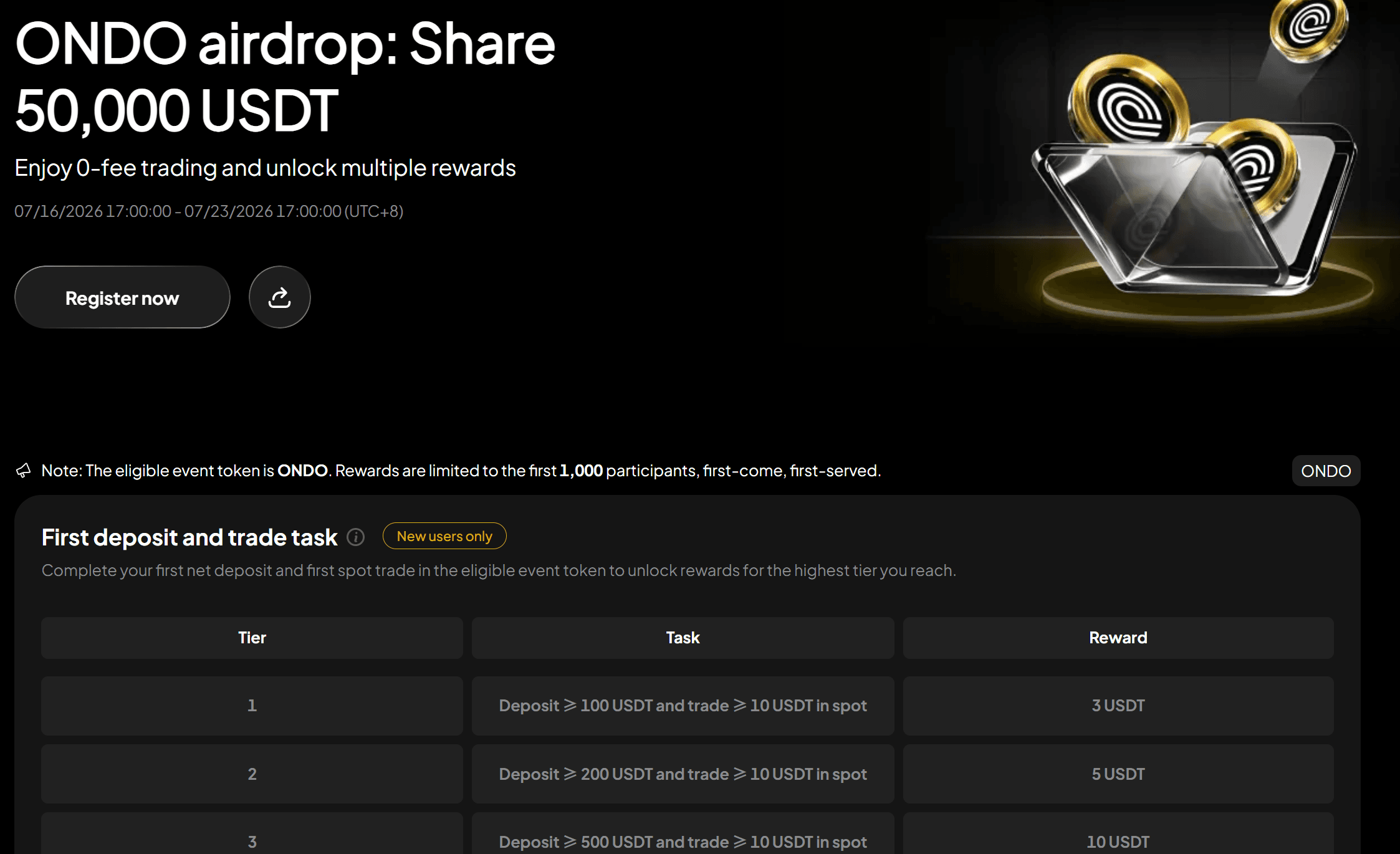
Claim ONDO Airdrop Rewards: Complete Tasks and Share 50,000 USDT
Claim ONDO Airdrop rewards on WEEX and share 50,000 USDT. Learn how to join, complete trading tasks, earn bonuses, and trade ONDO/USDT during the event.
How Overseas Crypto Exchanges Work for Japan Residents (and the Risks)
Modelo 721 Explained: Declaring Foreign Crypto Holdings in Spain
DEX vs CEX for Perpetuals: Trading Perps On-Chain vs on an Exchange
What Is an On-Chain Order Book? How Order-Book DEXs Work
What Is a Perp DEX? Perpetual Futures on Decentralized Exchanges
Italy Crypto Tax 2026: The Capital Gains Rate Rises to 33%
Support and Resistance: How to Identify Key Levels on the Chart
Supply and Demand Zones: A Smart-Money Trading Guide
How to Import Your WEEX Trade History into Cryptact (for Japan Crypto Tax Filing)
Best Crypto Apps and How to Choose One (2026)
How to Get Started with Crypto: From Account to First Purchase (2026)
How to Buy Bitcoin (BTC): A Beginner's Step-by-Step Guide (2026)
How to Buy Crypto in Indonesia for Beginners (2026): Register, Deposit, and Buy Bitcoin
Best Crypto Trading App & APK in Indonesia (2026): Features, How to Download Safely, and What to Check
Contents
Latest articles



Latest coin listings on WEEX


