
Polymarket Fee Surge Explained: Where Did 90%+ of Extreme Fees Come From?

 Prefer us on Google



Original Title: "Deep Dive into Polymarket's Fee Formula: How Did 90%+ Extreme Fee Rate Come About?"
Original Author: Azuma, Odaily Planet Daily
Polymarket suddenly found itself in a fee controversy.
Many community users discovered last night that when trading on Polymarket, they were charged unusually high fees, resulting in a significant reduction in received shares or earnings compared to before.
Overseas user Frosen (@frosen) even posted a screenshot, indicating that they tried to place an order for 100 shares at a price of 0.1 cents in an "economics" market, but the Polymarket frontend displayed a correct payout amount of only $5.2 (which should normally be $100) — corresponding to an outrageously high fee rate of 94.8%!
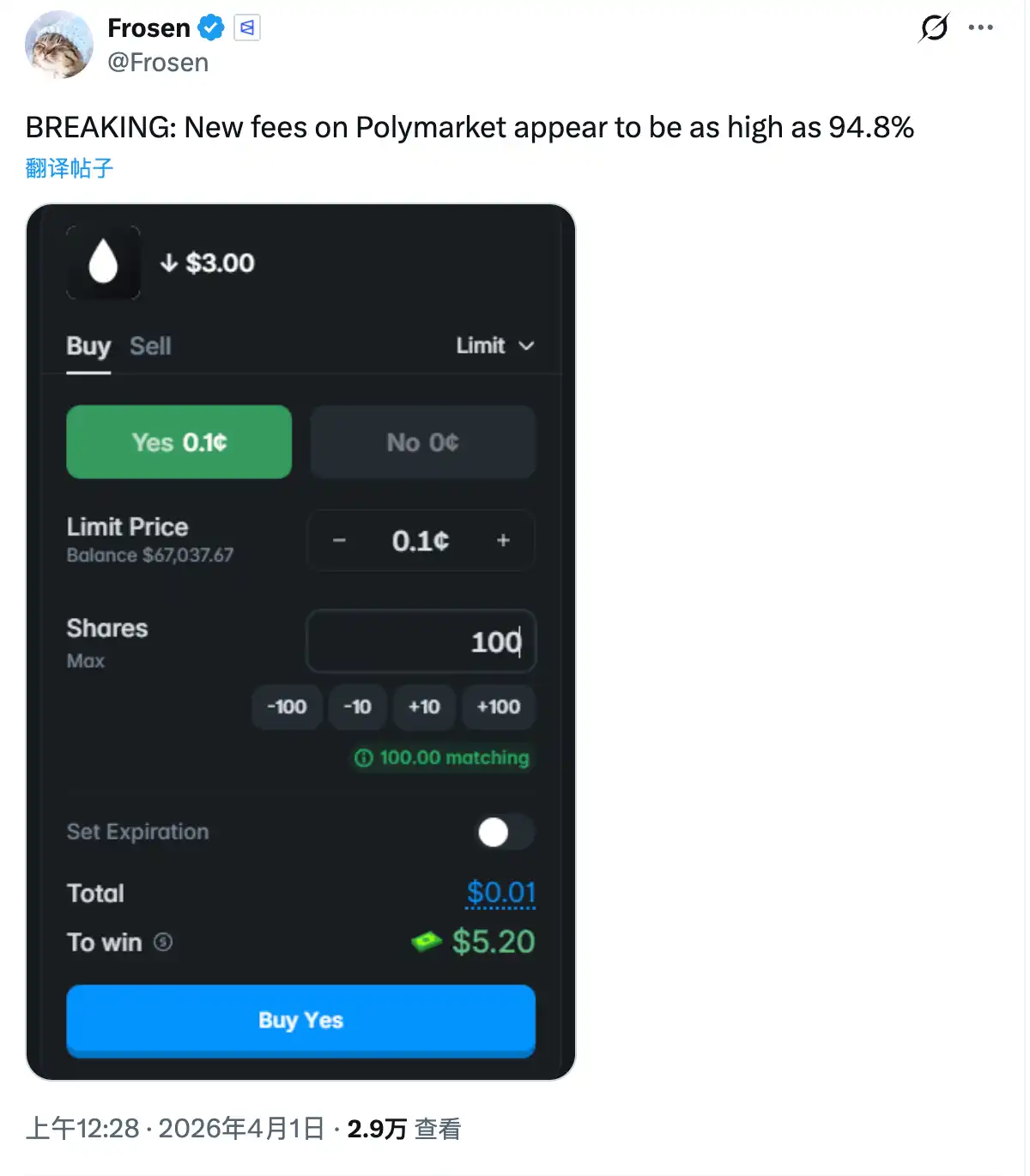
What's going on? Is Polymarket going crazy for money? Odaily, based on Polymarket's official disclosure and community investigation, found that the direct cause of this unexpected situation was that Polymarket modified the platform's fee formula last night, with three versions of changes:
· First was the "old formula" introduced since March 30: fee = C × p × feeRate × (p × (1 - p))^exponent;
· Then came the first modification, the formula that caused the unexpected situation (referred to as the "abnormal formula"): fee = C × feeRate × (p × (1 - p))^exponent;
· Subsequently, after realizing the issue, Polymarket made corrections, resulting in the current version of the "new formula": fee = C × feeRate × p × (1 - p);
· It's important to note that in all three formulas, C refers to the number of shares traded, p refers to the share price, and feeRate and exponent are variables.
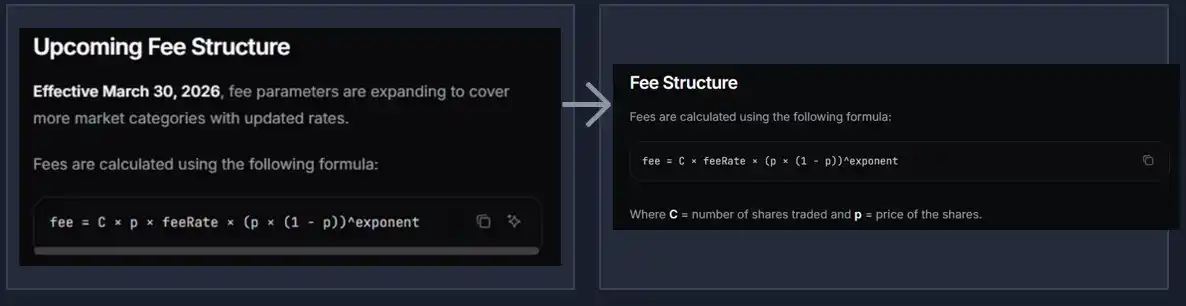
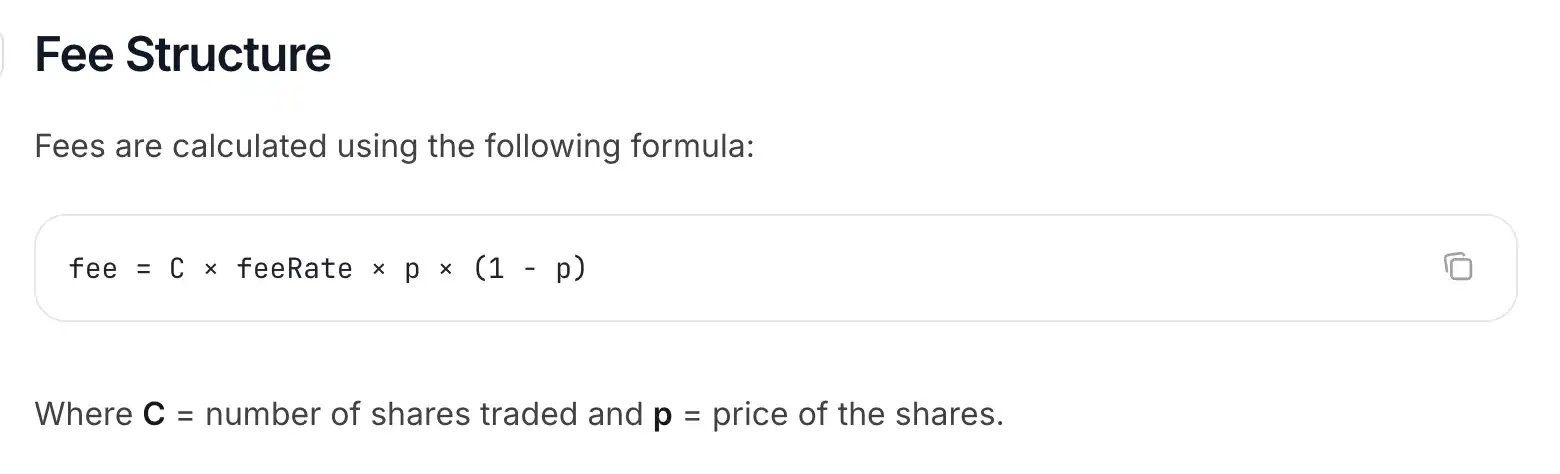
Decoding the Abnormal Formula, How Did the 94.8% Outrageous Fee Rate Occur?
You don't need to worry too much about the math details. By comparing the "Old Formula" and "Anomalous Formula," you can easily see that the latter only removes one "× p" (this is the multiplication symbol, not the lowercase x), meaning it ultimately multiplies the share price one less time.
Since the price of all shares on Polymarket is always less than 1 USD, this will inevitably lead to a overall increase in fees. The lower the price of shares, the more significant the fee increase due to skipping one multiplication — when the share price approaches 0, the fee rate may become absurdly high.
As for how absurd this fee can become, it also depends on the same variable ^exponent present in both the Old Formula and Anomalous Formula. Translated directly, ^exponent means "raised to the power of exponent," and this variable is mainly used to control the steepness of the fee curve.
According to Polymarket staff member Mustafa, the anomaly formula introduced last night only included the exponent in two types of markets: "Weather" and "Economic." According to overseas KOL Quant Chad (@Autonomous_Chad), the exponent parameter set for these two major markets at the time was 0.5.
Now, going back to Frosen's case and plugging the corresponding numbers into the equation fee = C × feeRate × (p × (1 - p))^exponent from this anomaly formula. Knowing that C equals 100, meaning Frosen wants to place an order for 100 shares; p equals 0.001, meaning 0.001 USD (0.1 cents); exponent equals 0.5, meaning another power operation on (p × (1 - p)); the final fee rate is 94.8%.
By feeding this to an AI directly, you can reverse-engineer that the feeRate level at that time was around 0.03, while also reconstructing the formula calculation details that Polymarket applied to this order.
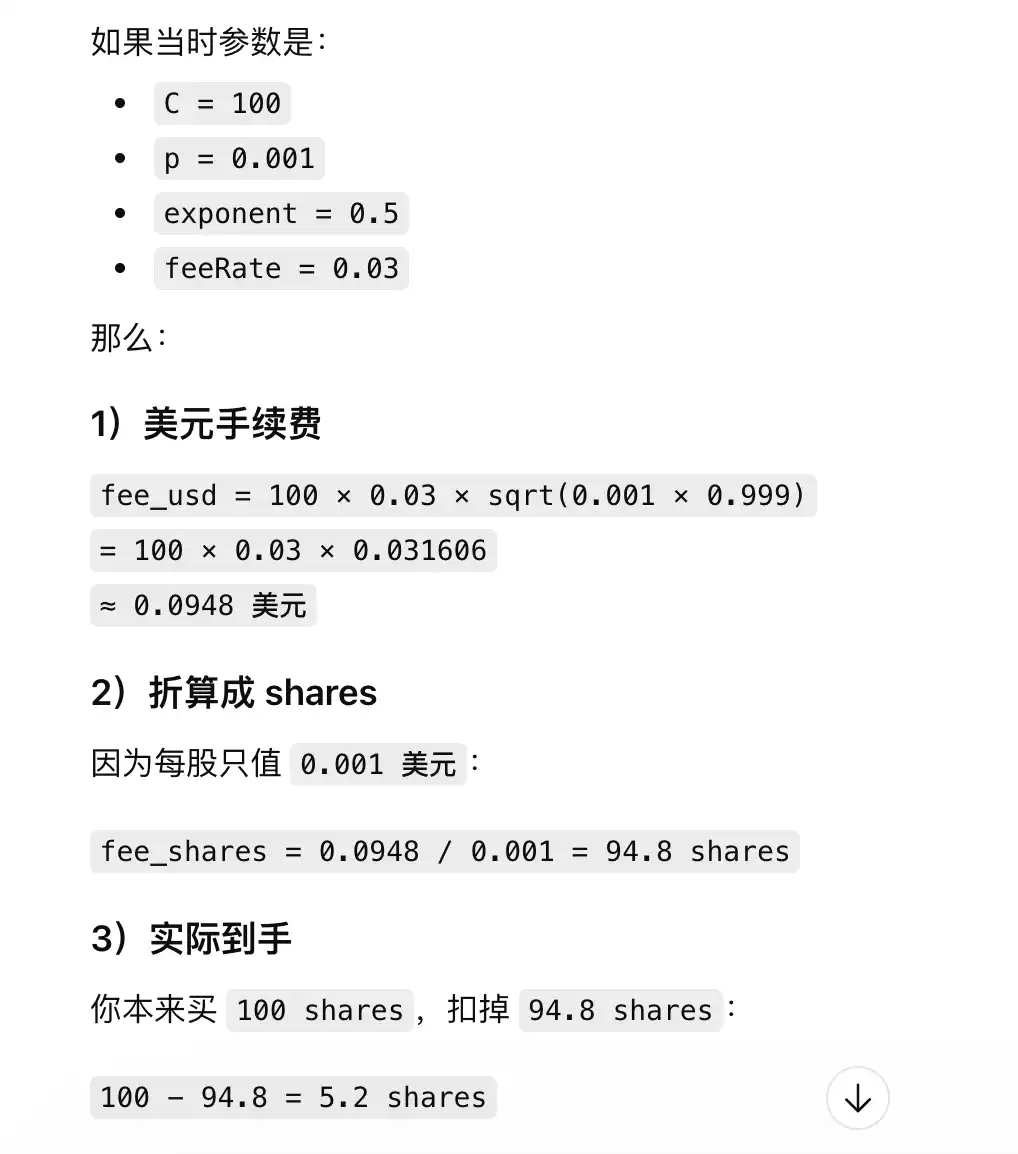
In simple terms, Polymarket calculated, based on the anomalous formula, that the fee for this order should be 0.0948 USD. Since Polymarket deducts the corresponding value of shares directly from the buy order, and the share price at the time was only 0.001 USD, it needed to deduct 94.8 shares. Therefore, Frosen would ultimately receive only 5.2 shares, even if the prediction is correct, the potential profit would only be 5.2 USD.
Polymarket Remedial Action
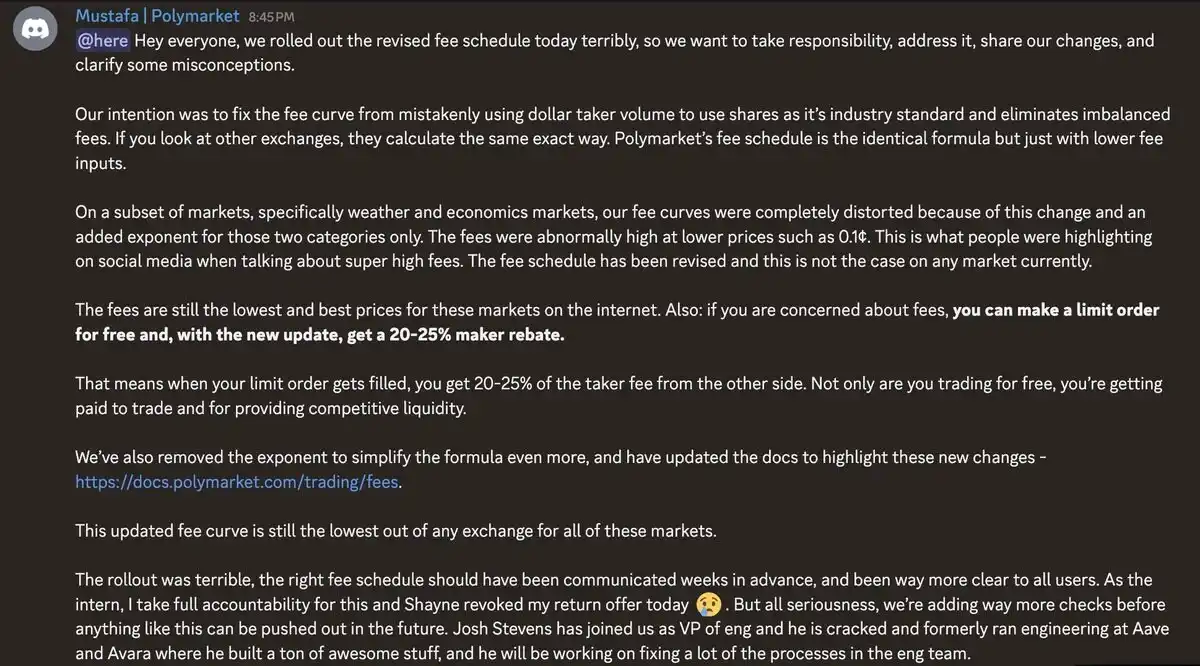
Shortly after the anomalous fee issue arose, Polymarket promptly responded by modifying the formula to its current version, fee = C × feeRate × p × (1 - p). Compared to the anomalous formula, the new formula removed the '^exponent'—effectively raising the exponent parameter from 0.5 to 1 in the anomalous formula fee = C × feeRate × (p × (1 - p))^exponent.
In the anomalous formula, the '^exponent' effect was to perform another power operation on the p × (1-p) data set. In Polymarket's actual operational scenario, the theoretical result range of p × (1 - p) is between '0.000999 - 0.25'—as p approaches 0.5 (shares price approaches $0.5), this data set gets closer to 0.25; when p approaches 0 or 1 (shares price approaches 0 or $1, with extreme quotes at $0.001 and $0.999), this data set gets closer to 0.000999.
Within the '0.000999 - 0.25' range, regardless of the value taken, raising the exponent parameter from 0.5 to 1 directly reduces the final fee result in the formula calculation, thereby decreasing the overall cost.
More importantly, this reduction has a more pronounced inhibitory effect on exceptionally high fees near very low price levels—when p × (1-p) = 0.000999, the fee under the new formula is only about 3.16% of the fee under the anomalous formula, representing a decrease of approximately 96.84%; when p × (1-p) = 0.25, the fee under the new formula is 50% of the fee under the anomalous formula.
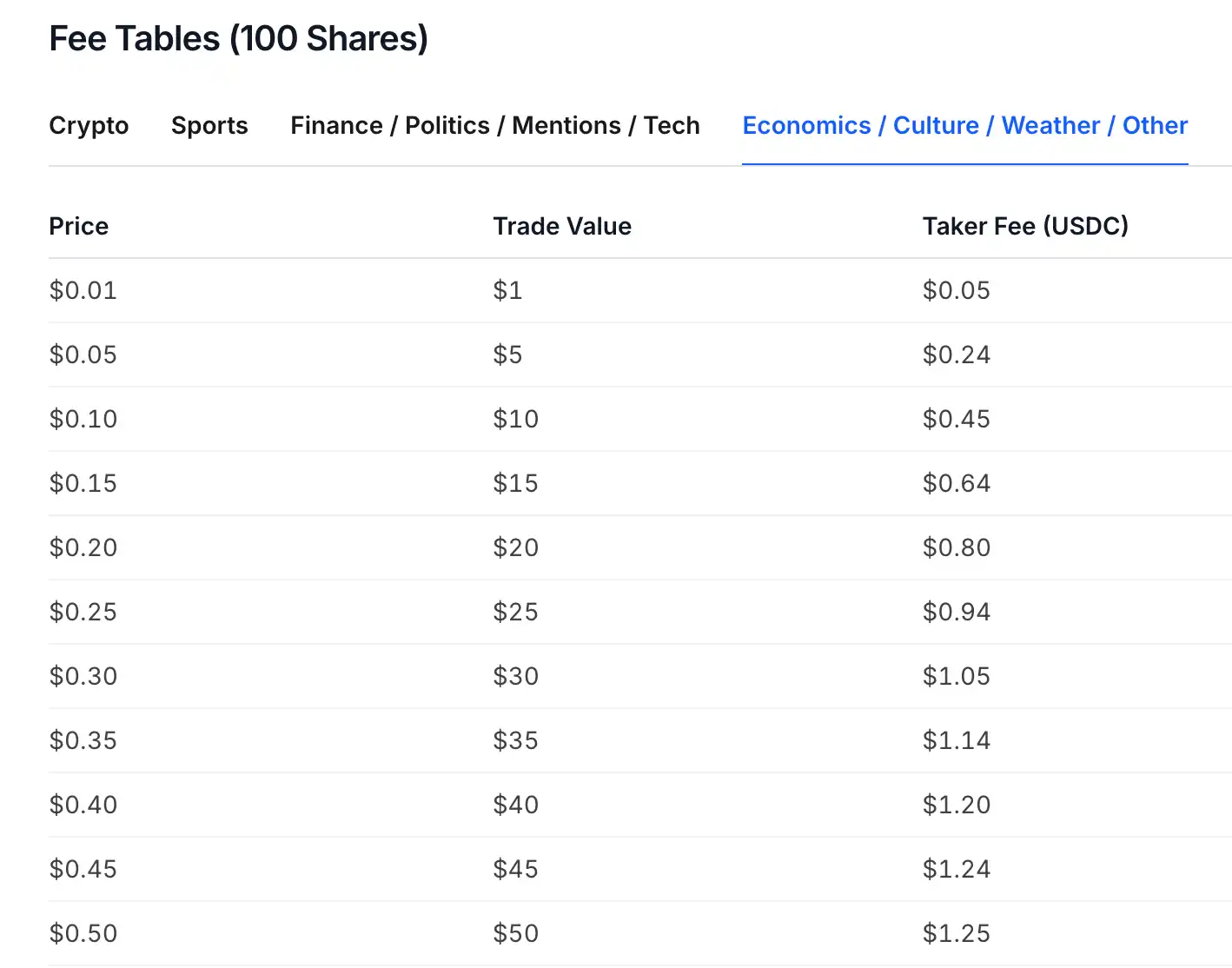
As indicated in the Polymarket official documentation, following the implementation of the new formula, fee rates at extremes in the 'Weather' and 'Economics' market categories have now decreased to 5%.
How Can Retail Users Avoid Fees?
I know most users are lazy to look at the above formula, but are also concerned about Polymarket's current fee issue.
In response to this, Mustafa mentioned on the official Discord: "If you're worried about fees, you can place limit orders for free, and after this new update, you can also receive a 20%-25% maker rebate—this means that when your limit order is executed, you will receive 20%-25% of the taker fee, essentially enabling you to not only trade for free but also potentially earn rewards by trading and providing competitive liquidity."
So let's change our habits, try not to market buy directly anymore, switch to using limit orders more often, and you can also try using Polymarket's Split feature more frequently, indirectly build your position by selling the other side of the shares through a reverse limit order.
Disclaimer: This content is provided for general branding and informational purposes only and doesn't constitute financial, investment, legal, or tax advice. Any events, rewards, online events, or related information mentioned herein should not be considered a recommendation, solicitation, or invitation to purchase, sell, trade, or otherwise deal in any crypto assets or to use any services. Crypto assets are highly volatile and may result in loss. WEEX services and online events may not be available in all regions and are subject to applicable laws, regulations, and eligibility requirements. You are responsible for ensuring that your use of WEEX services complies with local laws and for carefully assessing the risks before participating in any crypto-related activities.
You may also like

Protecting Social Infrastructure through Games: The Frontline of Power and Local Government DX|WebX2026

Goldman Sachs: U.S. Inflation is Shifting from Localized to Widespread, but Far from Repeating the 2022 Crisis

Bitcoin in a Range: Is it a Signal for Accumulation? Crypto.com Highlights ETF Inflows and Regulatory Developments

Zcash Price Prediction: Can ZEC Hit $600 Before the July 28 Ironwood Upgrade?

Bank of Korea to Launch Phase 2 of CBDC Pilot in September, Targeting 500,000 Users

Coinbase backs tougher CLARITY Act as Trump ethics fight deepens
Pokémon Cards Become a Craze on Crypto Betting Platforms
Dash Financial Autonomy: The Future of Monetary Freedom
Decrypted Operation Target Claims He Shared Bitcoin Wallet Password with Third Parties and Was Wrongfully Arrested After Exchange Breach

Trump revives Chinese AI crackdown after Kimi K3 tops coding test
Ckpool Tests Stratum V2, but Warns It’s Not Suitable for Solo Bitcoin Mining

Will Companies Stop Accumulating Bitcoin? This Strategy Indicator is a Warning Sign

BlackRock Trillions: The Myth of the Record and the Siege on Financial Control

Record High for the World Cup: $5.7 Billion in Bets on Kalshi and Polymarket

Andy Burnham Sworn in as UK Prime Minister... "Ending Political Instability with a New Economic Model"

United Kingdom: Andy Burnham, a Prime Minister "convinced" by crypto at the gates of Downing Street

Aave Picks Chainlink CCIP As Default Standard For Cross-Chain sGHO
Who is Capturing Value in Web 2.5?

Tesla Earnings Put 11,509 BTC Treasury Back In Focus

Is Shiba Inu (SHIB) Dead? On-Chain Data Shows a Sad Reality
Why the U.S. Stock Market Often Declines During Midterms

Bitcoin BIP-361 Draft Puts Quantum Security Back On The Agenda
Former Microsoft AI Team Launches Skyfall AI, Plans to Invest $1 Million to Test 'AI CEO' Model
The fed chair who owned crypto just ruled out saving it
Europe Gets A Bitcoin-Backed Preferred Stock As Treasury Demand Spreads
Stock Market: After AI Euphoria, KOSPI Plummets and Triggers Market Alert
What is a tokenized deposit? Bank money goes on-chain
142 Gatherings, $98 Billion Blocked: The Anti-AI Data Center Revolt Gains Momentum
Why stablecoin wallets have no deposit insurance

Will Artificial Intelligence Destroy the Bitcoin Mining Economy?
Protecting Social Infrastructure through Games: The Frontline of Power and Local Government DX|WebX2026
Goldman Sachs: U.S. Inflation is Shifting from Localized to Widespread, but Far from Repeating the 2022 Crisis
Bitcoin in a Range: Is it a Signal for Accumulation? Crypto.com Highlights ETF Inflows and Regulatory Developments
Zcash Price Prediction: Can ZEC Hit $600 Before the July 28 Ironwood Upgrade?
Bank of Korea to Launch Phase 2 of CBDC Pilot in September, Targeting 500,000 Users
Coinbase backs tougher CLARITY Act as Trump ethics fight deepens
Contents
Latest articles


Latest coin listings on WEEX


