
Intel Stock Forecast: Can AI and 18A Foundry Drive INTC Growth?

 Prefer us on Google


Intel (INTC) is entering a critical transition period as the semiconductor industry undergoes another major shift driven by artificial intelligence. While AI infrastructure spending continues to create new opportunities across the chip industry, investors are watching whether Intel can capture meaningful growth from this trend through its data center products, AI accelerators, and advanced manufacturing strategy.
The key questions surrounding Intel stock are no longer limited to traditional PC demand. Instead, the market is focused on whether AI server demand can revive Intel’s data center business and whether its 18A advanced process technology can help the company regain competitiveness in chip manufacturing.
For users looking for alternative ways to gain exposure to Intel’s price movements, platforms such as WEEX provide USDT-based TradFi products. The WEEX INTC-USDT futures allows users to trade Intel-related price movements, but it does not represent direct ownership of Intel shares or provide shareholder rights.
Intel AI Strategy: Can AI Infrastructure Become a Growth Engine?
The growth of AI has reshaped the semiconductor market, but the opportunity is not evenly distributed across all chip companies. For Intel, the challenge is not whether AI demand exists, but whether the company can capture enough value from the expanding AI infrastructure market.
Intel is positioning its Xeon processors and Gaudi AI accelerators as solutions for data centers that require broader computing capabilities beyond GPUs. As enterprises expand AI applications, demand is expected to grow across multiple layers of infrastructure, including CPUs, accelerators, networking, and memory systems.
Intel still has advantages in enterprise computing, including its long-established x86 ecosystem and relationships with global businesses. However, the company faces strong competition. NVIDIA maintains a dominant position in AI acceleration through its CUDA ecosystem, while AMD continues to gain ground in server CPUs and AI-related products.
This means Intel’s AI opportunity depends less on competing directly with the largest GPU players and more on whether it can become a meaningful provider of enterprise AI infrastructure.
The market will pay close attention to whether Intel’s AI-related products translate into actual revenue growth rather than simply benefiting from broader AI enthusiasm.
Intel Foundry and 18A Process: The Biggest Test for INTC’s Future
Intel’s long-term recovery depends heavily on the success of Intel Foundry and its 18A advanced process technology.
Historically, Intel operated primarily as an integrated device manufacturer (IDM), designing and manufacturing its own chips. In recent years, the company has expanded its foundry strategy, aiming to compete with leading semiconductor manufacturers by offering advanced manufacturing services to external customers.
The 18A process is a key milestone in this strategy. The technology introduces innovations such as RibbonFET transistor architecture and backside power delivery, with the goal of improving chip performance and efficiency.
For Intel, 18A represents more than a technical upgrade. It is a test of whether the company can rebuild confidence in its manufacturing capabilities after several years of delays and competitive pressure.
If Intel successfully scales 18A production and attracts external customers, it could strengthen the company’s position in advanced semiconductor manufacturing. A successful foundry business could also reduce Intel’s dependence on traditional PC markets and create a new long-term revenue source.
However, challenges remain. Advanced manufacturing competition is determined not only by technology but also by production yield, cost efficiency, customer adoption, and the ability to deliver chips at scale. Intel will need to prove that significant manufacturing investments can generate sustainable returns.
Intel Stock Forecast: Key Factors That Could Impact INTC Price
Intel’s future stock performance will likely depend on several business factors rather than a single market trend.
| Factor | Potential Impact on INTC |
|---|---|
| AI server demand | Could support data center revenue recovery |
| Xeon and Gaudi adoption | Shows whether Intel can compete in AI infrastructure |
| 18A execution | Determines long-term manufacturing competitiveness |
| Foundry customer growth | Validates Intel’s new business strategy |
| Semiconductor cycle | Influences demand, pricing, and margins |
In a more positive scenario, continued AI infrastructure investment combined with successful 18A execution could improve market confidence in Intel’s turnaround strategy.
A more cautious scenario would involve gradual improvement but slower-than-expected AI adoption or limited Foundry contribution. In this case, Intel may continue facing pressure from competitors and investors waiting for stronger evidence of growth.
The main risk for INTC is that expectations around AI and advanced manufacturing move faster than the company’s actual business recovery. Technology investment alone does not guarantee financial improvement; execution remains the key factor.
How to Trade Intel Stock Exposure with INTC-USDT
Traditional investors typically gain exposure to Intel through brokerage accounts by purchasing INTC shares. However, some global users may face barriers such as regional restrictions, account opening requirements, identity verification procedures, or banking limitations.
In crypto trading ecosystems, some platforms offer TradFi products that allow users to trade the price movements of traditional assets using USDT. For example, the WEEX INTC-USDT futures provides exposure to Intel’s price movements without requiring a traditional brokerage account.
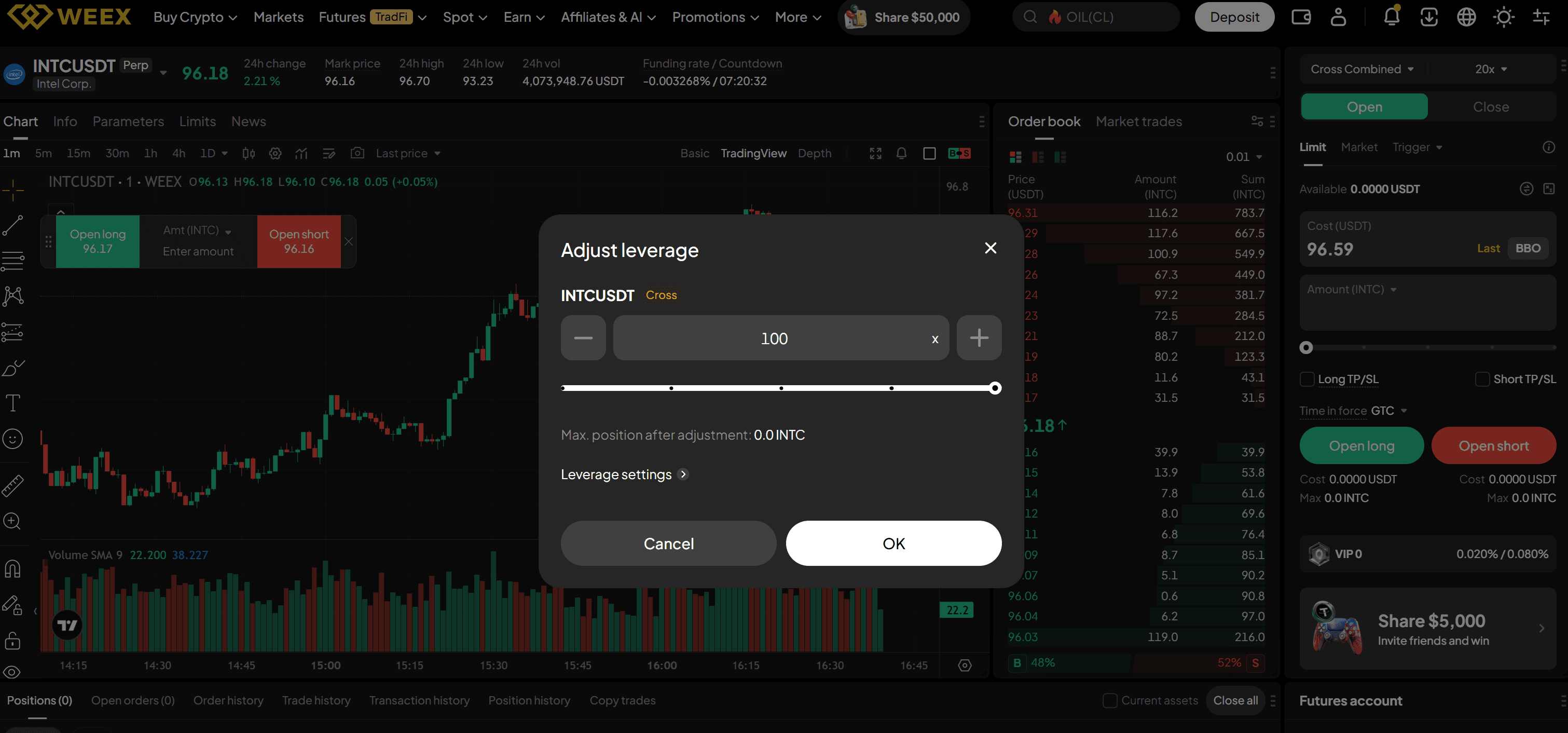
Users should understand that these products are different from owning Intel stock. They provide price exposure only and do not include shareholder benefits such as voting rights or dividends.
Before trading, users should consider factors such as product structure, market volatility, fees, and their own risk management approach.
Intel Stock Outlook: Can AI and 18A Change the Company’s Future?
Intel’s future growth depends on whether it can successfully execute two major strategies: becoming a stronger player in AI infrastructure and rebuilding its position in advanced semiconductor manufacturing.
AI provides Intel with a significant opportunity, but market enthusiasm alone will not determine the company’s recovery. Investors will need to monitor whether AI products generate real demand, whether data center revenue improves, and whether 18A technology achieves commercial success.
For INTC, the next stage is less about promising technology and more about execution. The company’s ability to turn large investments in AI and manufacturing into sustainable revenue growth will likely determine how the market evaluates Intel’s long-term outlook.
Disclaimer: This content is provided for general branding and informational purposes only and doesn't constitute financial, investment, legal, or tax advice. Any events, rewards, online events, or related information mentioned herein should not be considered a recommendation, solicitation, or invitation to purchase, sell, trade, or otherwise deal in any crypto assets or to use any services. Crypto assets are highly volatile and may result in loss. WEEX services and online events may not be available in all regions and are subject to applicable laws, regulations, and eligibility requirements. You are responsible for ensuring that your use of WEEX services complies with local laws and for carefully assessing the risks before participating in any crypto-related activities.
You may also like
How Will the CLARITY Act and Bank-Grade Stablecoin KYC Rules Change Crypto Trading in 2026
Why Is BitMine Buying Millions of Ethereum Tokens and Staking $9 Billion in ETH in 2026
How to Protect Your Bitcoin from Physical Attacks: Lessons From the NYC Crypto Torture Case in 2026
What Is the NYC Crypto Kidnapping Case? The Soho Bitcoin Attack Explained — 2026 Case Analysis
SpaceX Stock (SPCX): Now Public, and Back Where It Started
USA Rare Earth (USAR): What It Is and How to Trade the Token
NVIDIA Stock in 2026: Real Shares, Tokenized NVDA, and Perpetuals Compared
How to Buy USAR Coin: Buying Tokenized USA Rare Earth Stock the Right Way
WEEX Poker Party Series 4: Draw Cards to Split a $1M USDT Pool
Are Prediction Markets Legal? CFTC vs SEC Regulation Explained
Why Is TSMC Stock Down After a 77% Profit Jump? What Wall Street Is Actually Worried About
Is Samsung Stock a Buy at Its Lowest Level Since the AI Boom Began?
Samsung Stock and the KOSPI Bear Market: What the 30% Decline From Peak Tells Investors
Oil Price Above $90: What the US-Iran War Means for Your Portfolio Right Now
Iran War and Bitcoin: Why Crypto Is Not Acting Like a Safe Haven at $90 Oil
KOSPI Stock Market Enters Bear Market: What a 25% Drop From the Peak Means for Investors
KOSPI Stock Bear Market: What It Means for Samsung, SK Hynix and Korean Chip Stocks
Is the KOSPI Stock Market a Buy After Entering Bear Market Territory?
SK Hynix Leveraged ETFs SKHL SKHX SKHZ: What Each One Does and Who Should Use Them
Barclays Sees 70% Upside for SK Hynix Stock: What the Overweight Rating Means
Is SK Hynix Stock a Buy Now? What the 52 Week Low and IPO Price Break Tell Investors
Is This Really Messi's Last World Cup? What the 2026 Final Means for His Legacy
Who Is Ferran Torres? The Substitute Who Won the 2026 World Cup for Spain
2026 FIFA World Cup Winner: Spain Beats Argentina to Claim Second World Title
SK Hynix Stock: SKHY's Wild Nasdaq Debut and What Comes Next
JEPQ Stock in 2026: Price, Monthly Dividend, and Real Risks
FIFA World Cup 2026 Final Winner: Spain Beat Argentina 1-0 in Extra Time
Cathie Wood AMD Stock Sale: Why ARK Keeps Trimming a 140% Winner

Argentina vs Spain World Cup Final 2026: Score and Crypto Fallout
B2H Crypto Scam or Legit? Back 2 Humans Meme Coin Explained
How Will the CLARITY Act and Bank-Grade Stablecoin KYC Rules Change Crypto Trading in 2026
Why Is BitMine Buying Millions of Ethereum Tokens and Staking $9 Billion in ETH in 2026
How to Protect Your Bitcoin from Physical Attacks: Lessons From the NYC Crypto Torture Case in 2026
What Is the NYC Crypto Kidnapping Case? The Soho Bitcoin Attack Explained — 2026 Case Analysis
SpaceX Stock (SPCX): Now Public, and Back Where It Started
USA Rare Earth (USAR): What It Is and How to Trade the Token
Contents
Popular coins
Latest articles




