
How to Protect Your Bitcoin from Physical Attacks: Lessons From the NYC Crypto Torture Case in 2026

 Prefer us on Google



Key Takeaways
- Physical coercion attacks, known in security circles as "$5 wrench attacks," bypass blockchain cryptography entirely by targeting the human holder of a private key rather than the code itself, making them unstoppable through technical security alone.
- The 2025 Manhattan Soho case, where two crypto investors allegedly tortured an Italian national for 17 days to extract his Bitcoin password, is the most detailed documented wrench attack in US legal history and a direct case study for self-custody risk planning.
- Multi-signature wallet architecture requiring signatures from geographically separated key holders is the single most effective structural defense, since no individual under duress can unilaterally authorize a transaction.
- Time-delayed withdrawal mechanisms and decoy wallets with modest visible balances create a critical intervention window and a plausible surrender option that can end a coercion event without exposing an attacker's full target value.
- Operational security around wealth disclosure, including avoiding public statements about holdings size or portfolio value, remains the most underrated defense because target selection for physical attacks begins with visibility, not blockchain analysis.
Full Market and Narrative Summary
Physical attacks against cryptocurrency holders represent a structural risk category that no amount of cryptographic sophistication can eliminate, because the attack targets the person holding the key rather than the key's mathematics. The 2025 Manhattan Soho case, in which two crypto investors allegedly kidnapped and tortured an Italian national for 17 days to obtain his Bitcoin wallet password, has become the reference incident for this exact vulnerability. This article translates the specific mechanics of that case into an actionable security framework covering multi-signature custody, time-delayed withdrawal architecture, decoy wallet strategy, and operational security practices around wealth visibility. The goal is not theoretical risk education but a practical protocol that any self-custodied Bitcoin holder, from retail investors to high-net-worth allocators, can implement immediately to reduce both the likelihood of being targeted and the damage if a coercion event occurs.
Reducing physical attack exposure also requires understanding how different custody and execution environments distribute risk differently than pure self-custody. Reviewing the account security architecture, withdrawal controls, and custodial protections available on the WEEX Spot Market is a useful reference point for understanding how exchange-based custody trades certain risks, such as counterparty exposure, for protections against the specific physical coercion scenario this article addresses.
What Is a Wrench Attack and Why Does It Matter for Bitcoin Holders?
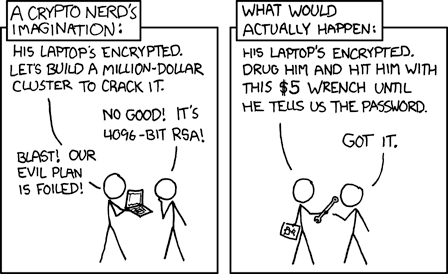
A wrench attack is a physical coercion method used to extract a private key, seed phrase, or wallet password directly from a cryptocurrency holder, named after a webcomic illustrating that a five-dollar wrench can defeat any amount of cryptographic security. Unlike a smart contract exploit, a phishing attack, or a private key brute-force attempt, a wrench attack requires no technical skill whatsoever; it requires only isolating the victim and applying sufficient physical or psychological pressure until the credential is voluntarily surrendered.
The reason this attack category is uniquely dangerous within crypto security is that Bitcoin's entire trust model assumes the private key holder is a rational, unthreatened actor acting under free will. Every security assumption built into elliptic curve cryptography, hardware wallet secure elements, and seed phrase entropy calculations presupposes that the person authorizing a transaction is doing so voluntarily. Once that assumption is violated through physical coercion, the resulting transaction is technically indistinguishable from a legitimate, voluntary transfer. The signature is cryptographically valid, the transaction propagates normally across the network, and it confirms with the same finality as any other Bitcoin transaction. There is no on-chain flag, no smart contract check, and no consensus-layer mechanism capable of detecting that a transfer was coerced rather than chosen.
The Manhattan Soho case is the clearest documented example of exactly this dynamic playing out in a US criminal court. According to the criminal complaint, the victim, a 28-year-old Italian national, was allegedly lured to New York in May 2025 under threats against his family, then held for 17 days inside an eight-bedroom townhouse while being subjected to beatings, electric shocks from a cattle prod, forced narcotics use, and a threat of being thrown from a five-story staircase ledge, specifically to force him to surrender his Bitcoin wallet password. He eventually complied, believing he was about to be shot, and escaped only because his captors had to retrieve a laptop to access the wallet, giving him a narrow window to flee. This sequence of events demonstrates precisely why technical security measures, however sophisticated, cannot substitute for a coercion-resistant custody architecture.
How Did the NYC Crypto Torture Case Expose Structural Custody Failures?
The Soho case exposed a specific and repeatable failure pattern: single-signature, single-location custody creates one point of total compromise, and that point is the human body of the holder. Prosecutors allege the victim held his entire accessible Bitcoin position behind a single password stored on a personal laptop, meaning that once the attackers isolated him physically, there was no secondary authorization requirement, no distributed signing structure, and no time delay that could have interrupted the transfer even after the password was extracted.
This single-point failure is architecturally identical to any single-signature wallet configuration, whether secured by a hardware device, a software wallet, or a custodial exchange account with only password-based access. The core lesson is that self-custody's security guarantee, often summarized as "not your keys, not your coins," only holds if the holder's physical safety cannot be compromised. Once physical coercion enters the threat model, sole custodial control becomes a liability rather than an asset, because it means exactly one point of physical compromise fully exposes the entire position with no procedural recourse.
The case also reveals a secondary structural issue: target selection. Court records indicate the defendants knew the victim personally, meaning the initial vulnerability stemmed not from on-chain wallet visibility but from social proximity and known wealth. This distinguishes the case from more commonly discussed wrench attack scenarios involving anonymous criminals tracking large wallet addresses through blockchain explorers. It demonstrates that operational security failures around disclosing crypto wealth to acquaintances, business partners, or on social platforms can be just as dangerous as on-chain exposure, since attackers do not need blockchain analysis tools if the target has already made their holdings known through personal or professional relationships.
What Custody Architecture Actually Prevents a Wrench Attack?
Multi-signature wallet configurations are the most direct and effective structural defense against physical coercion because they require signature authorization from multiple, independently held keys before any transaction can execute. In a properly configured multi-signature setup, such as a 2-of-3 or 3-of-5 threshold scheme, an attacker holding one victim under duress cannot produce the additional required signatures without also physically compromising the other key holders, who are ideally located in separate geographic jurisdictions, held by separate trusted parties, or secured through institutional custody arrangements entirely disconnected from the primary holder's daily life.
The practical design consideration for multi-signature setups intended specifically as coercion resistance, rather than simple redundancy against key loss, is ensuring that no single individual, including the primary account holder, can unilaterally authorize a transaction under any circumstances. This differs from a typical 2-of-3 setup designed for inheritance or backup purposes, where the primary holder retains two of the three keys for convenience. A coercion-resistant configuration should distribute keys such that the primary holder controls at most one signing key, with the remaining threshold requirement held by parties who are not immediately reachable by an attacker holding the primary victim.
Time-delayed withdrawal mechanisms provide a second, complementary layer of protection. These can be implemented either through custodial account settings that impose a mandatory delay between a withdrawal request and fund release, or through smart contract-based vault structures on programmable blockchains that encode a time-lock directly into the withdrawal logic. The critical function of a time delay is not preventing the coerced authorization request itself, since an attacker can still force the victim to initiate the request, but creating a window during which the legitimate holder, once released, can contact the custodian or invoke a cancellation mechanism to halt the pending transfer before it finalizes.
| Custody Architecture | Physical Coercion Resistance | Primary Limitation | Best Suited For |
|---|---|---|---|
| Single-key self-custody (hardware wallet) | Very Low | One point of physical compromise | Small, disposable balances only |
| Multi-signature (2-of-3, distributed) | High | Requires trusted, separated co-signers | Long-term holdings, high-net-worth individuals |
| Time-delayed withdrawal vault | Moderate-High | Delay window can be inconvenient for legitimate use | Large balances requiring liquidity flexibility |
| Centralized exchange custody | Moderate | Introduces counterparty and platform risk | Active trading capital, smaller reserves |
| Decoy wallet with visible balance | Moderate | Only effective if attacker unaware of true holdings | Individuals with known or suspected wealth |
Decoy wallet architecture is a third, more psychological mitigation. Maintaining a wallet with a modest, plausible balance that can be surrendered under duress, while the substantial majority of holdings remain secured behind a separate, non-disclosed multi-signature or time-delayed structure, gives a coercion victim a genuine option to comply and potentially end the immediate threat without exposing their full position. This strategy is only effective if the attacker has no independent way of verifying total holdings, which reinforces why avoiding public disclosure of wallet size or net worth is inseparable from any technical custody strategy.
What Operational Security Practices Reduce Wrench Attack Targeting?
Avoiding public disclosure of cryptocurrency holdings is the highest-leverage operational security practice because target selection for physical attacks begins with perceived wealth, not blockchain forensics. Publicly discussing portfolio size, posting screenshots of exchange balances, or being known within a social or professional circle as a large Bitcoin holder creates the exact visibility that initiated the Soho case, where prosecutors allege the defendants specifically targeted someone they knew personally and understood to hold significant crypto wealth.
This principle extends beyond social media to professional and social circles more broadly. Conference attendance, public speaking engagements about personal crypto success, and even casual conversations about specific holding amounts all contribute to a visibility profile that can be exploited. Security researchers who study wrench attacks consistently note that many documented cases, including internationally reported incidents in France, the Netherlands, and elsewhere, involved victims who had some degree of public visibility around their crypto wealth, whether through media appearances, social media activity, or word-of-mouth reputation within local crypto communities.
A second operational practice involves compartmentalizing knowledge of custody arrangements even among trusted associates and family members. If a coercion-resistant multi-signature structure exists but the victim's captors are aware of exactly how many signatures are required and who holds them, an attacker with sufficient resources and time could theoretically attempt to coerce multiple parties simultaneously. Limiting disclosure of the specific custody architecture, not just the balance, adds a further layer of protection by increasing the attacker's uncertainty about what is actually achievable through coercion.
A third practice involves maintaining a credible, low-friction compliance path. Security experts generally advise against configuring a custody structure that makes compliance under duress impossible, since attackers who realize a victim genuinely cannot produce funds regardless of cooperation may escalate violence rather than de-escalate. The decoy wallet strategy addresses this directly by giving a victim something real to surrender, ending the immediate physical threat, even though it does not represent their full holdings.
How Do Institutional and Retail Holders Differ in Their Physical Risk Exposure?
Institutional and high-net-worth individual holders face materially different physical risk profiles than typical retail holders, primarily because of visibility and perceived payoff rather than technical custody differences. An attacker planning a wrench attack is making a cost-benefit calculation, weighing the legal risk and effort of a violent crime against the expected cryptocurrency payoff, and retail holders with modest five- or low-six-figure positions generally represent insufficient expected value to justify the planning, risk, and potential prison exposure associated with kidnapping or torture charges, which in the Soho case reportedly carry sentencing exposure of 15 years to life for assault charges and 25 years to life for the kidnapping charge itself.
High-net-worth individuals, publicly known crypto founders, and early Bitcoin adopters with historically documented large holdings represent a fundamentally different risk calculation for a potential attacker, which is why institutional custody solutions, professional multi-signature services, and dedicated physical security arrangements have become increasingly standard practice among this population since wrench attacks began receiving sustained media attention. This does not mean retail holders face zero risk, particularly if their holdings become known within a specific social or professional context, as occurred in the Soho case, but it does mean that the intensity and cost of a coercion-resistant custody architecture should scale proportionally with both actual holdings and perceived visibility, rather than applying a uniform security posture regardless of exposure level.
What Should a Bitcoin Holder Do Right Now to Reduce Physical Attack Risk?
The most immediately actionable step for any self-custodied Bitcoin holder is auditing current custody architecture against a specific question: could a single coerced individual, under sufficient duress, unilaterally authorize a transfer of the full holding right now? If the answer is yes, meaning a single seed phrase, single hardware device, or single password provides complete access, that configuration represents an unmitigated physical coercion risk regardless of how sophisticated the underlying cryptographic security is.
Implementing a distributed multi-signature structure, even a relatively simple 2-of-3 configuration with keys held across separate physical locations or trusted institutional custodians, meaningfully closes this gap for holdings above whatever threshold an individual considers material. Pairing this with strict operational security around wealth disclosure, avoiding conversations, social media posts, or professional disclosures that reveal specific holding sizes, addresses the target selection phase that precedes any physical attack. For holders who prioritize liquidity and trading speed over the specific coercion-resistance properties of cold multi-signature storage, understanding the account security settings, withdrawal delay configurations, and custodial protections available on a regulated platform is a reasonable complementary approach, and reviewing what the WEEX Spot Market offers in terms of account protection and withdrawal controls provides a useful comparison point against pure self-custody exposure. No single custody model eliminates every risk category simultaneously, and the most defensible long-term approach separates active trading balances, appropriately sized for acceptable risk, from long-term holdings secured behind a genuinely coercion-resistant structure, continuing to refine that framework as both personal circumstances and the broader threat landscape evolve.
Frequently Asked Questions About Protecting Bitcoin From Physical Attacks
1. What is a $5 wrench attack in cryptocurrency
A $5 wrench attack refers to using physical coercion, such as violence or threats, to force a cryptocurrency holder to surrender their private key or password, rather than attempting to break the underlying blockchain cryptography. The term originates from a webcomic illustrating that a cheap tool used as a weapon can defeat any level of cryptographic security if the human holder can be physically threatened, making it a purely human-layer vulnerability rather than a technical one.
2. How does multi-signature custody protect against physical coercion
Multi-signature custody protects against physical coercion by requiring signatures from multiple independent key holders before a transaction can execute, meaning an attacker holding one victim under duress cannot unilaterally authorize a transfer. Configurations such as 2-of-3 or 3-of-5 threshold schemes are most effective when the additional required signers are geographically separated and not reachable by the same attacker, ensuring that compromising one person is insufficient to move funds.
3. What happened in the NYC crypto torture case that relates to Bitcoin security
The NYC crypto torture case involved two cryptocurrency investors allegedly kidnapping and torturing an Italian national for 17 days in a Manhattan townhouse in May 2025 to force him to reveal his Bitcoin wallet password. The case is significant for Bitcoin security because it demonstrates in explicit legal detail how single-signature, single-location custody creates one point of total physical compromise that no cryptographic safeguard can prevent once an attacker isolates the holder.
4. Can a time-delayed withdrawal actually stop a wrench attack
A time-delayed withdrawal cannot prevent an attacker from forcing a victim to initiate a withdrawal request, but it creates a mandatory waiting period during which the legitimate holder, once safe, can cancel the pending transaction before funds are actually released. This intervention window is why time-delayed vault structures and custodial withdrawal delay settings are considered a meaningful complementary defense alongside multi-signature architecture, rather than a standalone solution.
5. Should I hide how much Bitcoin I own to avoid being targeted
Yes, avoiding public disclosure of cryptocurrency holdings size is one of the most effective preventive measures because target selection for physical attacks typically begins with perceived wealth visibility rather than blockchain analysis. Publicly discussing portfolio value, posting balance screenshots, or being known within social or professional circles as a large holder increases the likelihood of being identified as a target, as documented in several wrench attack cases including the Manhattan Soho incident.
Disclaimer: This content is provided for general branding and informational purposes only and doesn't constitute financial, investment, legal, or tax advice. Any events, rewards, online events, or related information mentioned herein should not be considered a recommendation, solicitation, or invitation to purchase, sell, trade, or otherwise deal in any crypto assets or to use any services. Crypto assets are highly volatile and may result in loss. WEEX services and online events may not be available in all regions and are subject to applicable laws, regulations, and eligibility requirements. You are responsible for ensuring that your use of WEEX services complies with local laws and for carefully assessing the risks before participating in any crypto-related activities.
You may also like

How Will the CLARITY Act and Bank-Grade Stablecoin KYC Rules Change Crypto Trading in 2026
Why Is BitMine Buying Millions of Ethereum Tokens and Staking $9 Billion in ETH in 2026

What Is the NYC Crypto Kidnapping Case? The Soho Bitcoin Attack Explained — 2026 Case Analysis

SpaceX Stock (SPCX): Now Public, and Back Where It Started
USA Rare Earth (USAR): What It Is and How to Trade the Token
NVIDIA Stock in 2026: Real Shares, Tokenized NVDA, and Perpetuals Compared

How to Buy USAR Coin: Buying Tokenized USA Rare Earth Stock the Right Way
WEEX Poker Party Series 4: Draw Cards to Split a $1M USDT Pool
Who Really Makes Money on Prediction Markets? Smart Money vs Retail Traders
The Hidden Problem With Prediction Markets: Who Pays the Winners?
Prediction Markets Are the Future of Finance or Just Gambling?
How Polymarket and Kalshi Turned Predictions Into a Billion-Dollar Business

Why Prediction Markets Are So Hard to Regulate: The CFTC vs SEC Debate
Are Prediction Markets Legal? CFTC vs SEC Regulation Explained

Why Is TSMC Stock Down After a 77% Profit Jump? What Wall Street Is Actually Worried About
Is Samsung Stock a Buy at Its Lowest Level Since the AI Boom Began?
Samsung Stock and the KOSPI Bear Market: What the 30% Decline From Peak Tells Investors
Oil Price Above $90: What the US-Iran War Means for Your Portfolio Right Now
Iran War and Bitcoin: Why Crypto Is Not Acting Like a Safe Haven at $90 Oil
KOSPI Stock Market Enters Bear Market: What a 25% Drop From the Peak Means for Investors
KOSPI Stock Bear Market: What It Means for Samsung, SK Hynix and Korean Chip Stocks
Is the KOSPI Stock Market a Buy After Entering Bear Market Territory?
SK Hynix Leveraged ETFs SKHL SKHX SKHZ: What Each One Does and Who Should Use Them
Barclays Sees 70% Upside for SK Hynix Stock: What the Overweight Rating Means
Is SK Hynix Stock a Buy Now? What the 52 Week Low and IPO Price Break Tell Investors
Is This Really Messi's Last World Cup? What the 2026 Final Means for His Legacy
Who Is Ferran Torres? The Substitute Who Won the 2026 World Cup for Spain
2026 FIFA World Cup Winner: Spain Beats Argentina to Claim Second World Title
SK Hynix Stock: SKHY's Wild Nasdaq Debut and What Comes Next
JEPQ Stock in 2026: Price, Monthly Dividend, and Real Risks
How Will the CLARITY Act and Bank-Grade Stablecoin KYC Rules Change Crypto Trading in 2026
Why Is BitMine Buying Millions of Ethereum Tokens and Staking $9 Billion in ETH in 2026
What Is the NYC Crypto Kidnapping Case? The Soho Bitcoin Attack Explained — 2026 Case Analysis
SpaceX Stock (SPCX): Now Public, and Back Where It Started
USA Rare Earth (USAR): What It Is and How to Trade the Token
NVIDIA Stock in 2026: Real Shares, Tokenized NVDA, and Perpetuals Compared
Contents
Popular coins
Latest articles


