
Why Are You Always Losing Money on Polymarket? Because You're Betting on News, While The Rulebook Favors Insiders



Original Title: "Why Are You Always Losing Money on Polymarket? Because You're Betting on News While the Front-Runners Are Reading the Rules"
Do you know why you can't beat the frontrunners on Polymarket? Because they focus on the rules, scrutinizing them like a lawyer reviewing a contract.
In April 2026, a controversy about the Venezuelan leader on Polymarket caused a stir in the community.
There was a market on Polymarket asking, "Who will be the leader of Venezuela by the end of 2026?" Many traders' intuition was that since Maduro was in a U.S. prison and Delcy was running the cabinet in Caracas, it was clear that Delcy was the actual leader, so they bet on Delcy.
But the rules and additional explanations were very clear: "officially holds" refers to the person who has been officially appointed and sworn in. The UN-recognized Venezuelan government has not officially removed or replaced Maduro, and official government information still recognizes him as the president. The rules also specifically added: "Temporarily exercising presidential powers does not equate to a transfer of the presidency."
According to these rules, even if Maduro is still in a U.S. prison, he is still the legitimate president of Venezuela.
There are many similar examples:
· After Polymarket issued a stablecoin, there was a dispute over "What is the FDV of the Polymarket token": whether a stablecoin counts as a token, a difference of one word
· Iran Uranium: The standard for "agreement," conditional statement vs. formal signing of the agreement
Behind these examples is the same logic: on Polymarket, the rules are paramount. But when the rules are in dispute, Polymarket has a complete arbitration process to resolve it: this article will introduce how this mechanism works and where it is similar to, or fundamentally different from, traditional courts.
1. Polymarket's Arbitration Mechanism
The ambiguity in the rule text not only causes pricing differences but also turns into formal disputes during settlement.
Every day on Polymarket, there are numerous market settlements, with markets involving political statements, diplomatic positions, and military actions being particularly prone to disputes.
The dispute event is actually a common occurrence in prediction markets. Ambiguity during the trading phase creates pricing discrepancies, which turn into dispute conflicts during the settlement phase. It is the same issue manifesting differently at two different points in time.
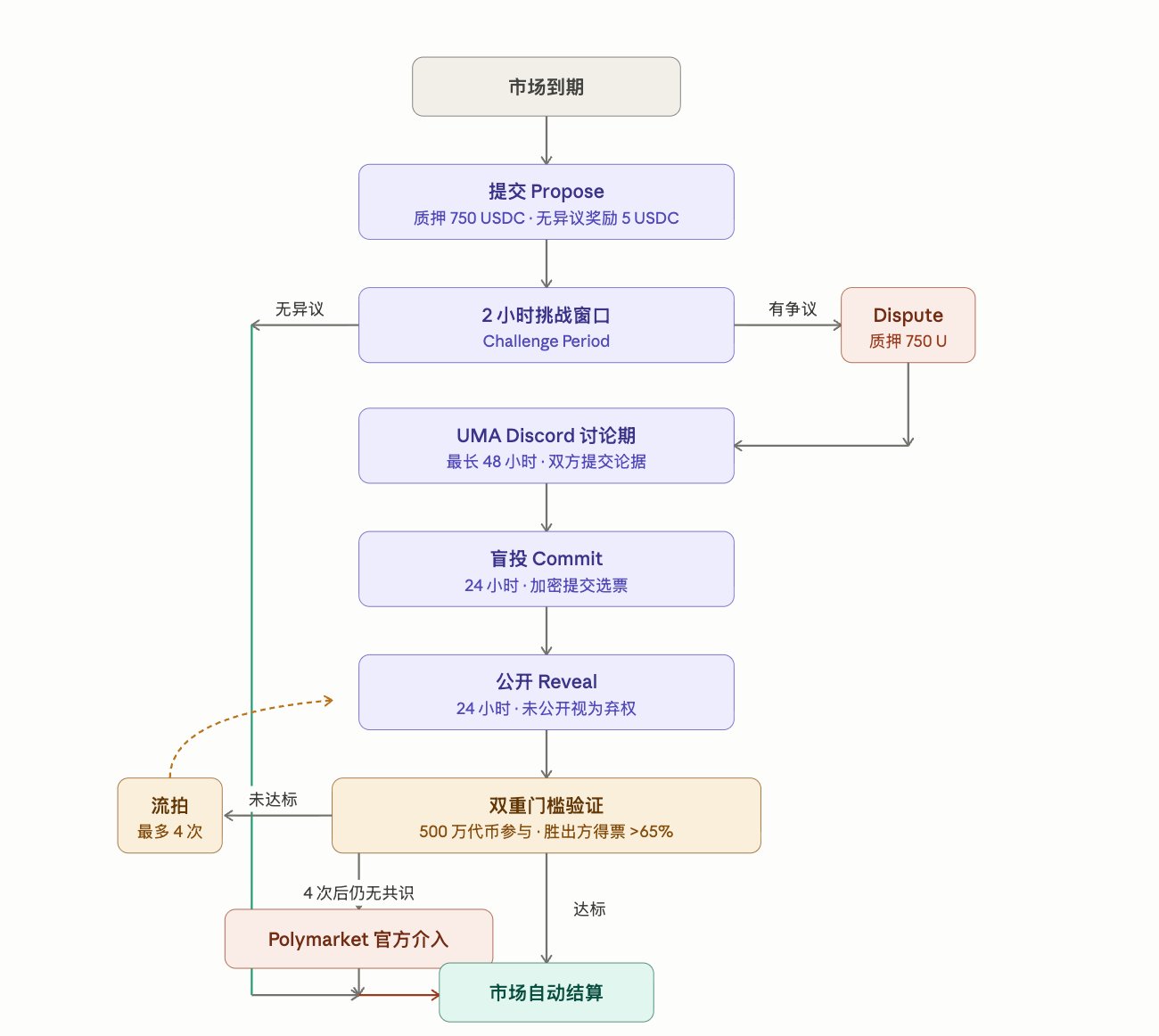
To address these disputes, Polymarket has established a comprehensive dispute resolution process. The settlement process follows two paths: normal settlement and dispute resolution.
Step 1: Submit Proposal
When a market meets the settlement conditions, anyone can submit a resolution outcome, stating whether this market should be resolved as YES or NO. When submitting a proposal, a deposit of 750 USDC is required as collateral. This deposit signifies the submitter's endorsement of their judgment. In the case of no disputes in the market, the user who submitted the proposal can receive a reward of 5 USDC.
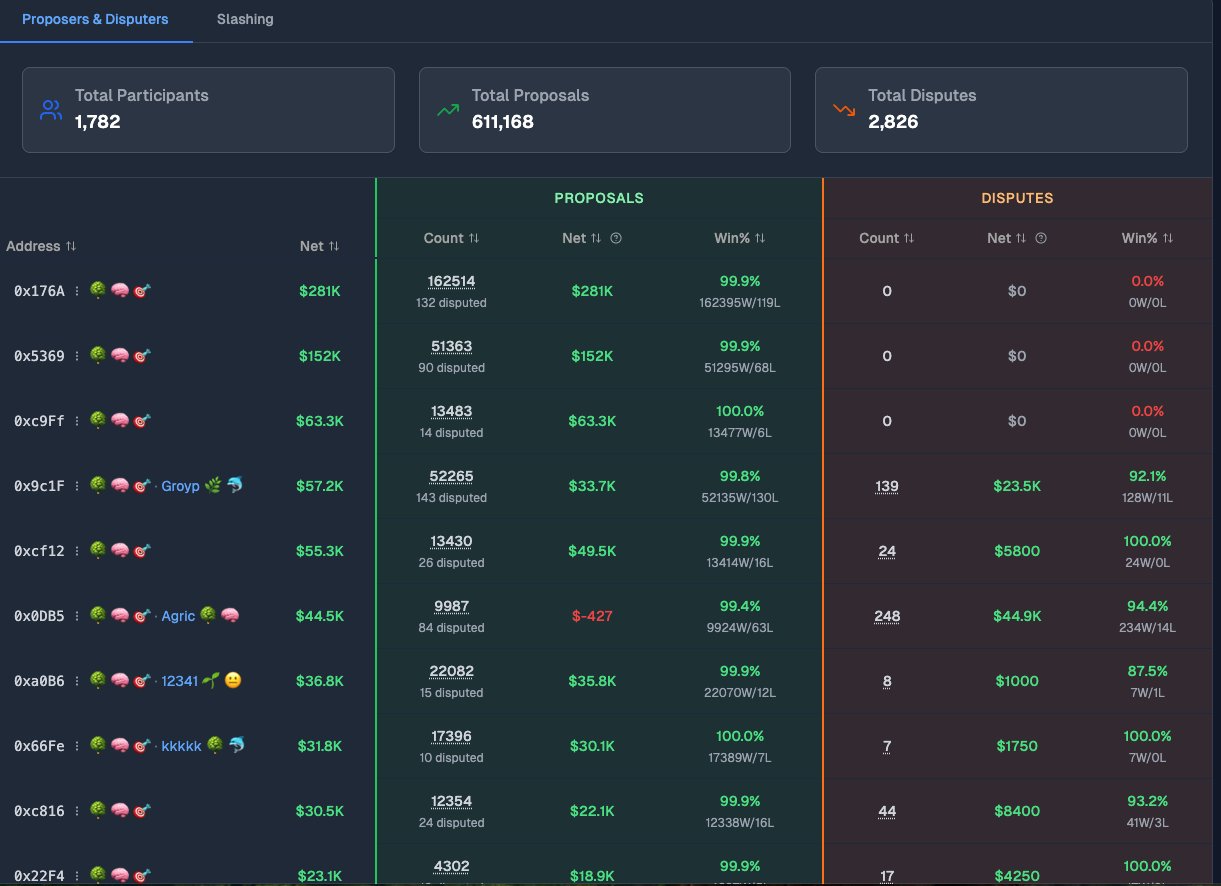
Currently, there are only 1782 users submitting proposals in the market, with the highest-earning user having accumulated $281K.
Step 2: 2-Hour Challenge Window (Dispute)
After the proposal submission, a 2-hour challenge period commences. This is the first fork in the entire process.
If no one raises an objection within 2 hours, the system defaults to the proposal being correct, and the market settles directly, concluding the process. The vast majority of markets follow this path.
If someone believes the proposal result is incorrect, they can challenge it within this 2-hour period, also requiring a 750 USDC deposit. A successful challenge can earn a bonus of 250 USDC.
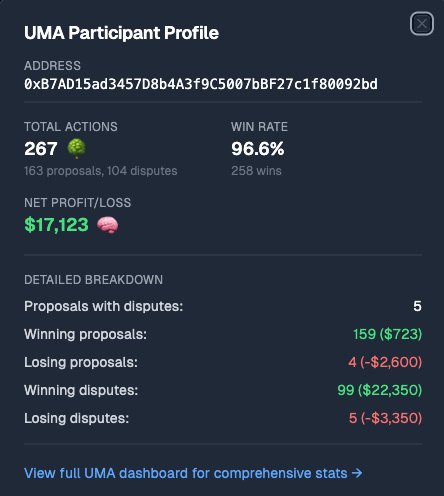
There are very few users in the market specifically dedicated to Dispute. The user who has earned the most during the Dispute phase is 0xB7A, with a profit of $17,123.
Step 3: Up to 48-Hour Discussion Period
Upon entering the dispute track, both parties enter the UMA Discord discussion phase. The purpose of this stage is for all parties to submit arguments and evidence: the interpretation of the rule text, relevant news coverage, historical precedents, official statements—any material that can support their position can be presented during this stage.
The discussion period lasts up to 48 hours and is the only stage in the entire process where arguments can be fully articulated. The quality of this stage significantly influences the direction of subsequent voting.
Step Four: 48-Hour Voting
After the discussion, we move to the UMA token holder voting phase, which is divided into two 24-hour phases.
· The first phase is blind voting. Each voter must make an independent decision based on their own understanding of the rules, rather than following large holders.
· The second phase is public voting. Any votes not made public in this phase are considered abstentions and are directly invalidated.
After the voting ends, UMA has set two settlement thresholds that must be met simultaneously to reach a resolution:
· Participation Threshold: At least 5 million tokens must participate in the vote to ensure an adequate representation for the decision.
· Absolute Consensus Threshold: The winning side must have a vote share of over 65%, rather than a simple majority of 51%.
If these two thresholds are not met simultaneously, the vote is inconclusive, leading to the next round of voting, with a maximum of 4 re-votes. If there is still no consensus after 4 rounds, Polymarket officially reserves the right to intervene for a decision.
Step Five: Automatic Settlement
Once the voting results are confirmed, the market automatically settles, and funds are distributed according to the results. There is no appeals process, no retrials, and no recourse.
The entire dispute process, from challenge submission to final settlement, typically concludes within one week.
II. Polymarket vs. Traditional Courts: Same Logic, Different Design
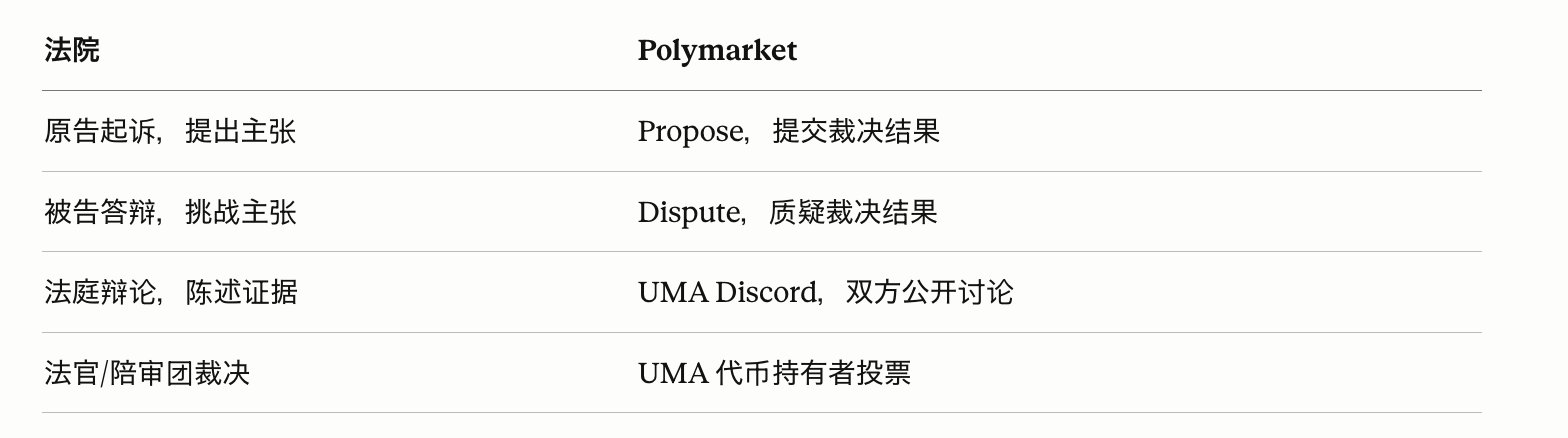
On the surface, Polymarket's arbitration process appears highly similar to traditional courts: both have a claimant, a respondent, a discussion phase, and ultimately a decision-maker providing a ruling.
However, these two systems are fundamentally different in one key aspect: Separation of Powers.
1. Segregation of Powers in Courts
In traditional courts, the plaintiff and defendant only have the right to present their cases, not to decide. Judges solely hold the power to make judgments and do not have a vested interest. Most importantly, judges must maintain independence from the cases they preside over. If there is any conflict of interest between a judge and a case, recusal is mandatory, and a different judge must oversee the case.
The judge and the interested party are never the same person.
2. Polymarket Does Not Have This Separation
UMA token holders are the judges, but they can also hold positions in the dispute market. Ruling in a certain direction directly impacts their own profits and losses. When the judge and the interested party are the same person, it is called a conflict of interest in traditional courts and would be required to recuse, but in Polymarket, this is legal and normal.
This design flaw is the root of the following two issues.
1. Why the Discussion Phase Fails
In a courtroom, the positions of the plaintiff and the defendant are fixed from the moment of filing. Lawyers do not switch sides midway through a trial or withdraw their statements because the other party seems stronger. The positions are clear, the roles are defined, and the entire argument is built on this stability.
The UMA Discord discussion faces two issues simultaneously.
· Herd Mentality: Discussions are conducted openly and under real identities. Once an influential KOL expresses an opinion, it easily sways others to follow suit. Many participants only post a single line like "P1" or "P2" without providing any reasons.
· Position Shift: Participants in the discussion also hold positions in the dispute market. As their positions change, their stances naturally follow suit. This is why there are often cases in the UMA Discord where opinions are shared and then deleted.
The root cause of these two issues is the same: there is no separation between the judge and the interested party. The court system uses a mechanism of recusal to separate these two roles, ensuring the stability of positions during the discussion. Polymarket does not have this separation.
2. Why the Ruling Result is Not Transparent
In a courtroom, after hearing the complete statements from both sides, the judge issues a ruling. The ruling document clearly states which party's arguments were accepted, what the basis was, and why the decision was made. The losing party may disagree, but at least they know where they lost and can strengthen their arguments for the next time.
These rulings form a system of precedents that can be studied. Subsequent judges, lawyers, and parties can refer to these, making the judgment standards open, learnable, and predictable.
After the UMA vote concludes, there is only one result: YES or NO. The two sides of the discussion do not know what the voters saw, believed, or why they leaned one way. The winning side does not know which argument was effective, and the losing side does not know where their argument lacked persuasiveness. Because the rationale behind the judgment is not made public, the outcome of the dispute is difficult to study and build upon.
The court's judgment forms the basis of a precedent system, with Polymarket's ruling leaving only one outcome.
III. Final Thoughts
Therefore, Polymarket has never been merely a "guess the event" market; it is more like a system that translates real-world events into legal text and then translates legal text into settlement outcomes.
Understanding the rules and conducting research are equally important. The edge often comes from a deep understanding of the rules, knowing what this system acknowledges and what the rulings will recognize.
Those who can recognize the gap between "reality" and "rules" early on are more likely to seize the opportunity to earn from the price divergences created by misunderstanding, dispute, and emotion.
Original Article Link
You may also like

Galaxy Deep Research Report: How Hyperliquid's HIP-4 Upgrade Changes the Landscape of Prediction Markets?

ZachXBT: Humanity private key leak and abnormal surge in H token should be viewed separately
On June 9, according to related disclosures, on-chain investigator ZachXBT posted an update on Humanity’s roughly $31 million security incident, saying that after further analyzing fund flows, he currently tends to believe the project team was not involved in an “inside job” or a self-staged attack. According to him, the official explanation about the private key leak was broadly accurate, but before the token unlock, the price of H had been artificially pushed higher, and the hacker later took advantage of that market environment; therefore, the private key leak and the earlier abnormal price pumping should be regarded as two separate and independent events. This reframing has shifted the market’s understanding of the nature of the incident. Earlier discussion around Humanity had focused on whether the team directly participated in the attack or used the security incident to cover up internal operations. ZachXBT’s latest remarks shift the focus from “whether it was self-theft” to “whether there were pre-unlock market structure issues.” He also questioned whether the team may have.

Morning Report | OpenAI has submitted an S-1 registration statement draft to the U.S. SEC; Morpho completes $175 million financing

Morning Report | BitMine increased its holdings by 126,971 ETH last week; trader Eugene announced his exit from the crypto market

Wang Chuan: How can one not feel anxious after the neighbor Old Wang made thirty times profit by investing in storage stocks? (Seven) - A quarter-century cycle

Cryptocurrency CEXs are flocking to sell US stocks, and traditional brokerages are facing an "uninvited guest."
$75 billion in foreign capital has fled, and South Korean retail investors have absorbed it all using leverage

Japan’s Three Megabanks Plan Joint Stablecoin Issuance in Fiscal 2026
MUFG, SMBC, and Mizuho reportedly plan to jointly issue fiat-pegged stablecoins in fiscal 2026, signaling Japan’s growing push into bank-led digital payment infrastructure.

Humanity Discloses H Token Dual-Chain Attack Details, With Losses on Ethereum and BSC Exceeding $36 Million
Humanity said the H token attack across Ethereum and BSC caused more than $36 million in losses after leaked ProxyAdmin keys enabled malicious contract upgrades and token minting.
White House Discusses CLARITY Act With Law Enforcement Ahead of Senate Vote
The White House discussed the CLARITY Act with law enforcement ahead of a Senate vote, focusing on illicit finance risks and developer protections.

Bitcoin Trading Guide 2026: Strategies for Experienced Traders

What Is XAUT and PAXG? Why Tokenized Gold Is Booming in 2026

Will the SpaceX IPO Hurt Bitcoin? Here's What Traders Are Watching

Foreign selling in the South Korean stock market accelerates, with cumulative net sales reportedly reaching $75 billion this year
On June 9, The Kobeissi Letter, citing Goldman Sachs data, reported that global investors are selling South Korean stocks at an unusually rapid pace. In the latest trading session, foreign investors sold about $801 million worth of Kospi constituent stocks again; total foreign outflows last week reached about $10 billion, and the market has been in net foreign selling on nearly every trading day over the past month. According to the data cited in the report, foreign investors have sold about $75 billion worth of South Korean stocks so far this year. Meanwhile, South Korean retail and institutional investors together recorded roughly $69 billion in net buying over the same period, suggesting that the market’s main buying support has come from domestic capital rather than returning overseas funds. The information currently disclosed still mainly comes from The Kobeissi Letter’s retelling and Goldman Sachs data summaries, while public details on the statistical period and the specific definition of “selling” remain relatively limited.

Fortune Warns of Strategy’s Financing Structure Risks as Bitcoin Premium Narrows
Fortune warned that Strategy’s Bitcoin treasury model faces growing financing risks as MSTR’s net asset premium narrows and preferred stock dividend pressure increases.

Ferrari Challenge Le Mans: Carl Moon to Dominate in WEEX Livery

Sahara AI Responds to SAHARA’s Sharp Drop: No Contract or Product Security Issues Found, Internal Investigation Underway
Sahara AI responded to SAHARA’s 60% price drop, saying no token contract or product security issues have been found and an internal investigation is underway.

WEEX Deposit/Withdrawal Dynamic Island: Your Asset Status, Always in Sight
Galaxy Deep Research Report: How Hyperliquid's HIP-4 Upgrade Changes the Landscape of Prediction Markets?
ZachXBT: Humanity private key leak and abnormal surge in H token should be viewed separately
On June 9, according to related disclosures, on-chain investigator ZachXBT posted an update on Humanity’s roughly $31 million security incident, saying that after further analyzing fund flows, he currently tends to believe the project team was not involved in an “inside job” or a self-staged attack. According to him, the official explanation about the private key leak was broadly accurate, but before the token unlock, the price of H had been artificially pushed higher, and the hacker later took advantage of that market environment; therefore, the private key leak and the earlier abnormal price pumping should be regarded as two separate and independent events. This reframing has shifted the market’s understanding of the nature of the incident. Earlier discussion around Humanity had focused on whether the team directly participated in the attack or used the security incident to cover up internal operations. ZachXBT’s latest remarks shift the focus from “whether it was self-theft” to “whether there were pre-unlock market structure issues.” He also questioned whether the team may have.
Morning Report | OpenAI has submitted an S-1 registration statement draft to the U.S. SEC; Morpho completes $175 million financing
Morning Report | BitMine increased its holdings by 126,971 ETH last week; trader Eugene announced his exit from the crypto market
Wang Chuan: How can one not feel anxious after the neighbor Old Wang made thirty times profit by investing in storage stocks? (Seven) - A quarter-century cycle
Cryptocurrency CEXs are flocking to sell US stocks, and traditional brokerages are facing an "uninvited guest."


