
The world's largest social platform Telegram has a major update: Your GPU can now mine TON.





Yesterday, Telegram founder Pavel Durov tweeted to announce that their decentralized privacy computing network, Cocoon, has officially launched.

The Cocoon network consists of 3 parts:
Client: Initiates work requests to the agent and pays the agent upon request completion.
Agent: Routes work requests to work nodes. The agent, protected by TEE, will select an appropriate node based on the device model, load, and reputation of the work node, and will transfer the fee collected from the client to the node, which will also deduct a certain commission. Telegram plans to allow anyone to run their own agent in the future, making the Cocoon network fully decentralized.
Work Node: Executes AI inference requests in a TEE-protected virtual machine and is paid by the agent the fee from the client upon completion of the execution.
In other words, anyone can become a work node with their GPU to earn $TON. Cocoon enables GPU owners to contribute AI computing power to the decentralized network on TON by running the Cocoon protocol stack on a TEE-supported GPU server, providing private, verifiable AI model execution, and transparently receiving $TON payment for each processed request.
Pavel Durov stated that some AI-related features of Telegram, such as message translation, are already partially supported by Cocoon. He also mentioned Telegram's in-app features like speech-to-text and summarization, indicating that Cocoon initially lacks practical applications and believes that Telegram mini-programs will bring more demand for the Cocoon network in the future.
Compared to the previously hyped Telegram gift NFT in the crypto community, Cocoon is more like a decentralized AI computing network built by Telegram integrating blockchain and $TON as a payment method, stemming from the functional requirements within Telegram, with limited hype potential as it is unlikely to issue a coin. However, this project may reflect a long-term trend where there is increasing attention to the privacy concerns of exposing data directly to centralized AI giants when using AI. In the crypto community, we have seen more and more projects in the privacy track advocating for "protecting data sovereignty." (Related Read: 12 New Projects, an Overview of the Privacy Projects Officially Recognized by Solana)
Currently, the total TVL of the Cocoon Network has reached around 4487 TON, with 30 working nodes, 18 delegates, and 12 clients. This data is from just over 1 day since its official launch, still very early.
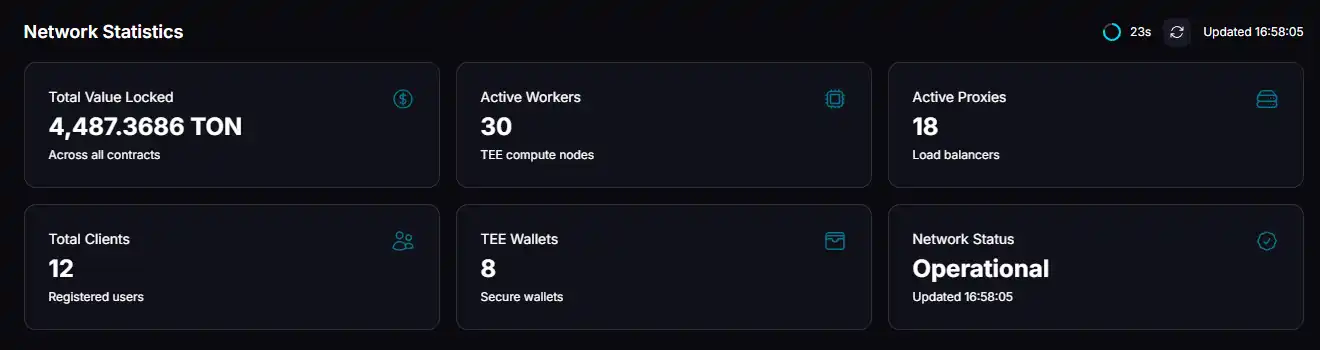
There is practical application demand supported by Telegram's built-in features and TON incentives. However, due to the presence of TON incentives, the expectation of coin issuance has also been reduced. Whether the Cocoon Network can follow a development pace different from that of typical cryptocurrency projects in the industry remains to be seen and will require time to validate.
You may also like

When the P2P illicit funds from ten years ago turned into 60,000 bitcoins

Morning News | CME Group launches Nasdaq Cryptocurrency Index futures; Asset management giant Janus Henderson strategically invests in Ethena

Why did Oracle deliver the strongest financial report in history, yet its stock price fell?

Bitcoin Layer 2 Network Botanix: Why Did We Choose to Dissolve?

Morning Report | OpenAI has submitted an S-1 registration statement draft to the U.S. SEC; Morpho completes $175 million financing

Galaxy Deep Research Report: How Hyperliquid's HIP-4 Upgrade Changes the Landscape of Prediction Markets?

Latest research from 13 top universities including Cornell University: The current state, challenges, and misconceptions of the fusion of Crypto and AI
Deconstructing Anthropic: The Best AI Company, Possibly Also a Type of Organizational Invention

Every exchange is a "Universal Exchange."

The counterattack of traditional finance: Alliance chains are quietly reviving
Pantera Capital Partner: How Tokenization is Restructuring the Private Equity and Early Investment Ecosystem?

Mastercard Launches Agent Pay for AI, Plans to Record AI Agent Payment Authorizations on Polygon
Mastercard launched Agent Pay for AI, a new payment protocol designed to help AI agents make small payments such as pay-per-use access to data and APIs. The system plans to record human-granted AI agent permissions on Polygon, focusing on verifiable authorization, identity, and payment controls.

Curve Deploys Llamalend v2 on Optimism With 250,000 OP Incentives
Curve launched Llamalend v2 on Optimism with 250,000 OP incentives from the Optimism Foundation. The upgrade expands Llamalend beyond its earlier crvUSD-focused model, adding broader collateral support, LlamaRisk market reviews, and the ability to use Curve LP tokens as collateral.

Raydium Old Liquidity Pool Reportedly Exploited, With $1.34 Million Moved to Ethereum and Tornado Cash
An old Raydium liquidity pool was reportedly exploited for around $1.34 million in USDC, RAY, and wSOL, with the stolen funds bridged to Ethereum and deposited into Tornado Cash. The incident highlights the tail risks of legacy DeFi pools, old contracts, and cross-chain fund laundering paths.
Kalshi Executive Challenges “SBF Backed AI Unicorns” Narrative, Says Leopold Aschenbrenner Was Key Figure
Kalshi executive John Wang questioned the “SBF backed AI unicorns” narrative, saying Leopold Aschenbrenner was the key figure behind major AI investment decisions.

New York Proposes Stricter Stablecoin Issuer Rules Aligned With Federal GENIUS Act
NYDFS proposed stricter stablecoin issuer rules aligned with the GENIUS Act, covering reserves, custody, redemption timelines, audits, and capital buffers.

CryptoQuant Says Bitcoin Profitable Supply Is Near 45% Pressure Zone as On-Chain Data Points to Market Repricing
CryptoQuant said Bitcoin’s profitable supply is nearing the 45% pressure zone, signaling rising market stress, unrealized losses, and a possible on-chain repricing phase.

Bitcoin Falls Below 200-Week Moving Average as On-Chain Data Shows Over Half of Supply in Loss
Bitcoin dropped below its 200-week moving average as on-chain data showed over 50% of circulating supply is now in loss, signaling rising market stress.
When the P2P illicit funds from ten years ago turned into 60,000 bitcoins
Morning News | CME Group launches Nasdaq Cryptocurrency Index futures; Asset management giant Janus Henderson strategically invests in Ethena
Why did Oracle deliver the strongest financial report in history, yet its stock price fell?
Bitcoin Layer 2 Network Botanix: Why Did We Choose to Dissolve?
Morning Report | OpenAI has submitted an S-1 registration statement draft to the U.S. SEC; Morpho completes $175 million financing
Galaxy Deep Research Report: How Hyperliquid's HIP-4 Upgrade Changes the Landscape of Prediction Markets?


