
Geopolitical Risk Persists, Is Bitcoin Becoming a Key Barometer?


Original Article Title: Can Liquidity Win the Battle Against the Next Phase of the Iran War? Why Bitcoin is Becoming a Reliable Liquidity Bellwether.
Original Article Author: Joe Duarte
Translation: Peggy, BlockBeats
Editor's Note: Just as the market was regaining upward momentum driven by liquidity, new uncertainty has been building up at the other end. The Iran situation has once again fluctuated, with the risk in the Strait of Hormuz looming large, bringing geopolitical conflict back to the core variables of asset pricing. In just a few days, the market shifted from a logic of "fund-driven" to a dual game of "liquidity vs. risk event."
The current market is caught in a tug of war between "liquidity-driven rally" and "risk impact from the escalation of the Iran situation." On one hand, the Federal Reserve and the U.S. Treasury injected nearly $200 billion of liquidity into the financial system in a short period, driving a rapid rebound in the stock market and risk assets; on the other hand, geopolitical uncertainty, private credit risks, and overheated sentiment have left the market fragile.
In this context, the role of Bitcoin is beginning to change. Unlike traditional risk assets, it is more sensitive to liquidity changes, often signaling first when the funding environment shifts. Based on historical experience, whether it was the early decline in October 2025 or the leading stabilization in the current rebound, Bitcoin has to some extent played the role of a "leading indicator."
Therefore, the question is no longer just "Will the market rise," but rather—when liquidity is still being unleashed and the risk of war resurfaces, which force will dominate pricing? If funds cannot sustainably hedge external shocks, then the current rally may just be a temporary mismatch; while if liquidity continues, the market may continue to rise amid volatility.
Next, the key lies not in a single variable, but in the relative strength between them. And Bitcoin may once again become the asset that provides answers first.
Below is the original text:
"Oh, think twice, 'cause it's another day for you and me in paradise." — Phil Collins
For traders and investors, Friday was an unusual trading day. But there is still some time left until Monday, and the market is already brewing a new variable—early Saturday morning news reports indicated that Iran's position on the Strait of Hormuz issue has shifted, which could once again trigger market turmoil.
In addition, Friday's rebound has pushed the market sentiment indicator (as seen below) to a relatively fragile position, making the market more prone to a pullback. This has put the market into a "tug of war": on one side is the massive liquidity injection mentioned below, and on the other side is the uncertainty brought about by a potential reversal in the Iran war situation.
What Just Happened?
Liquidity's impact on the market is facing a test—the adversary being the escalating Iran war turbulence.
Question: What happens if around $200 billion floods into the financial system almost simultaneously?
Answer: Asset prices will experience a sharp "melt-up."
Lately, I have been focusing on four common factors suppressing the stock market: Iran war, the ongoing financial system liquidity crunch since January this year, a generally pessimistic market sentiment, and a lack of understanding of the true state of the private credit market.
But last week, these factors were almost "completely overturned": liquidity crunch saw a reversal, the Iran situation seemed to ease, and the market's pessimistic sentiment was once again proven—it often serves as a precursor to a potential stock market rebound.
Have we averted the crisis? No one can be certain because the Iran situation is heating up again. Additionally, if investors reenter a "panic mode," liquidity may once again dry up. As for what has happened in the private credit market, we still lack clear understanding.
For now, let's focus on a relatively observable variable: liquidity.
Dual "Liquidity Tsunami"
If you are wondering where the funds that drove the stock market up in the past two weeks came from—think again: the answer is the Federal Reserve and the US Treasury. Around April 15, the two injected approximately $200 billion into the financial system, providing traders with a "tax day buffer."
First, let's look at the first "barrel"—the Federal Reserve.
On April 15, through repo operations, the Fed injected nearly $110 billion into the market (via Treasury securities and mortgage-backed securities). This alone was not insignificant, but more importantly, the Fed continues to inject about $40 billion per month into the market through its Reserve Management Purchases (RMP) program.
What's truly worth paying attention to is the second "barrel"—the US Treasury.
With Garret Baldwin's analysis, the U.S. Treasury injected approximately $1.4 trillion to $2 trillion into the market during the same period. In other words, roughly calculated, without any formal quantitative easing (QE) announcement, the Fed and the Treasury quietly infused nearly $2.4 trillion of liquidity into the market.
This explains why the stock market experienced an explosive rally.
The More Covert Part: Treasury's Operation
How did the Treasury carry out this "covert operation"?
The key lies in one account — held at the Fed's "U.S. Treasury General Account" (TGA). When the balance in this account rises, it usually signifies liquidity tightening; when it falls, it denotes liquidity release.
According to Garret's calculations, around tax day, the U.S. government's balance in this "checking account" at the Fed dropped from about $837 billion to around $697 billion. It then rose back to about $924 billion on April 15.
Critically, about $140 billion had already flowed into the banking system before tax day, meaning that before April 15, the financial system was actually in a "liquidity surplus" state.
Furthermore, the U.S. National Financial Conditions Index (NFCI, tracked weekly in this report) in the latest data (April 10) has reversed its previous tightening trend.
We highlighted this shift in the Smart Money Passport daily report: "The Fed injected approximately $10.5 billion into the financial system today, and the NFCI index dropped for the first time since January 23, 2026. The convergence of these two signals may suggest that the Fed has adjusted its liquidity tightening stance."
The biggest suspense now is whether liquidity can take the lead or if a new escalation in the Iran conflict will once again become the market's key variable.
Bitcoin Starts to "Get Active": Why It's a Liquidity Barometer
Next, Bitcoin's trend is crucial.
Because compared to stocks, Bitcoin is more sensitive to liquidity. Therefore, its recent surge above $75,000 and whether it can challenge the $80,000–$85,000 range are worth paying attention to.
From a technical perspective, the resistance in the $80,000–$85,000 range is not very strong. The Volume Profile of that range is relatively thin, indicating a lack of significant support during the previous downtrend. Therefore, under normal circumstances, this price level should not pose a strong resistance during a recovery.
If the price fails at this point, it means two things: first, the market lacks confidence in this rally, and second, there may be underlying liquidity issues. More importantly, if Bitcoin fails to break through this key level, it could also suggest that the "liquidity tsunami" generated by the Federal Reserve and the Treasury is rapidly receding.
If the market absorbs the $200 billion bank reserve liquidity within a few weeks, it would be a dangerous signal. This could indicate that private credit markets or other external risks are building up.
Remember, Bitcoin's decline in October 2025 accurately predicted the stock market's trouble in 2026. At the same time, Bitcoin stabilized weeks before the stock market bottomed out and led the rebound ahead of the liquidity injection by the Federal Reserve and the Treasury.
Against the backdrop of the ongoing developments in Iran and lingering global risks, Bitcoin's potential weakness should not be underestimated.
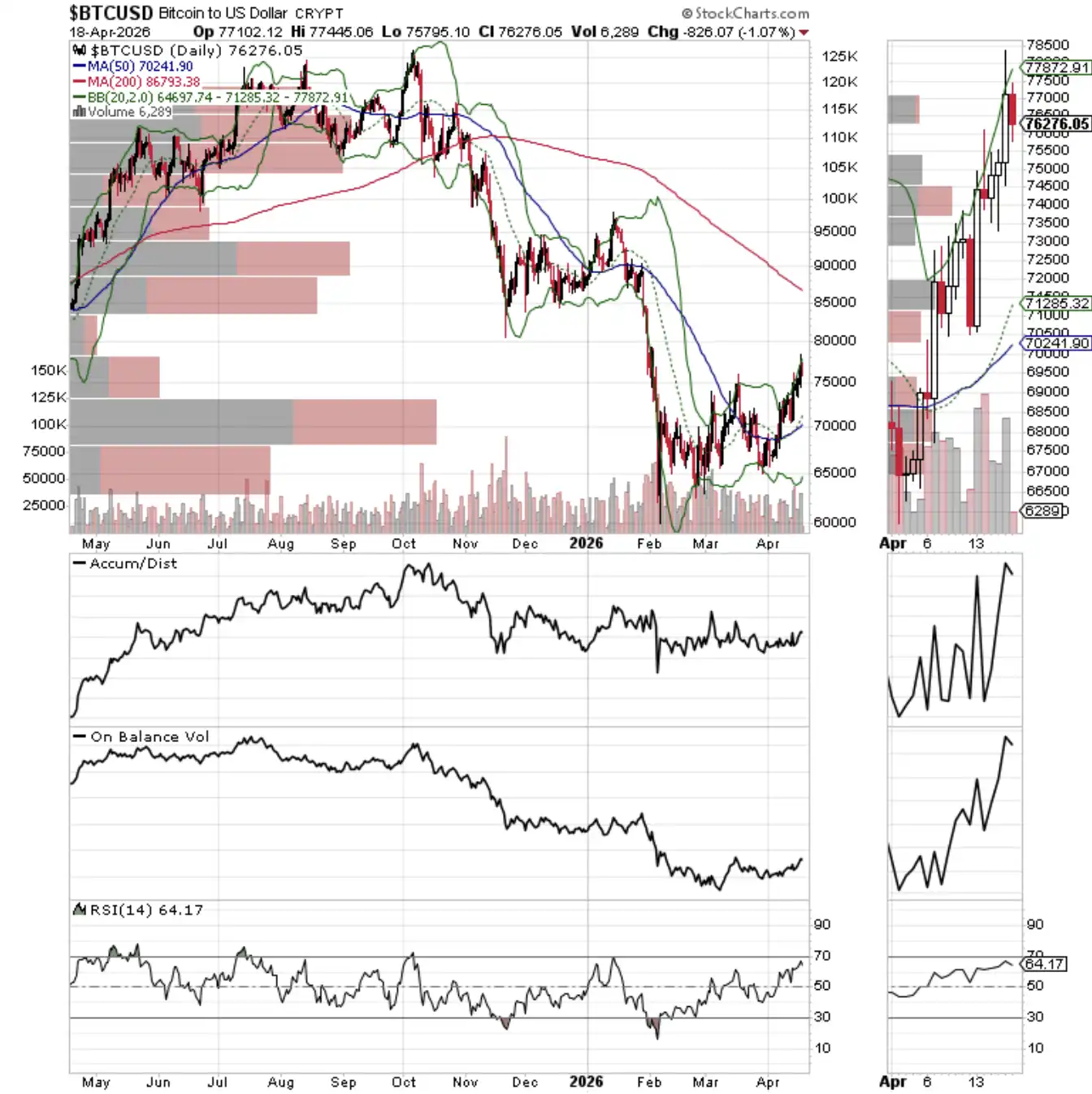
The $70,000–$75,000 range is a key support level.
Sentiment Summary: Sudden Market Shift to Overall Optimism
The CNN Fear & Greed Index closed at 68 on April 17, 2026, in the "Greed" territory.
The CoinMarketCap Crypto Fear & Greed Index stood at 59 on early Saturday, indicating a moderately high "Neutral" level.
The Chicago Board Options Exchange (CBOE) Put/Call Ratio is at 0.65, with the index options P/C ratio at 0.82. Currently, the options market sentiment remains neutral overall, but with bullish sentiment rapidly increasing, it is gradually shifting towards a bearish bias.
The CBOE Volatility Index closed at 17.48, which is a relatively positive level. However, it might still rise back above 20 in the short term (usually seen as a risk alert threshold).
It is worth noting that the VIX generally rises when traders heavily buy put options. Increased demand for put options forces market makers to hedge by selling stock index futures, thus exerting downward pressure on the market.
Conversely, when the VIX declines, it indicates a decrease in demand for put options, a shift in market sentiment towards optimism, and subsequently more call options buying. This prompts market makers to buy stock index futures to hedge risk, thereby increasing the probability of a stock market rally.
Liquidity Observation
1. Bullish: Liquidity is easing
The National Financial Conditions Index (NFCI), released by the Federal Reserve, had a latest reading of -0.47 on March 27, 2026 (released on April 10), further decreasing from the previous week's -0.44. This indicates a relaxation in the financial environment and an improvement in liquidity.
A decline in the NFCI is usually seen as a bullish signal, and a negative index implies that market liquidity is relatively abundant.
2. Bond Yields Retreat
The U.S. Treasury yields saw a retreat in the latter part of this week, but with the evolving situation in Iran, there is a possibility of them rising again in the future.
The U.S. 10-Year Treasury Yield closed below 4.3% this week and dropped below its 20-day moving average. A further drop below the 200-day average would be considered a bullish signal; conversely, a rise back above 4.5% could push the yield back to the high point of nearly 4.6% in May 2025.
3. NYAD, SPX, and NDX Simultaneously Hit New Highs
The NYSE Advance-Decline Line reached a new high, concurrently with the S&P 500 Index and NASDAQ-100 Index hitting new highs, forming a confirmation signal.
The current uptrend has been validated—but only temporarily. Once it falls below the 20-day or 50-day moving average, the market situation could change rapidly.
The NASDAQ-100 Index hit a new high last week, with 26,000 points now serving as short-term support.
The S&P 500 Index hit a new high last week and broke through the 7000-point mark. 7000 points are now serving as short-term support.
1111.4
You may also like

Every exchange is a "Universal Exchange."

The counterattack of traditional finance: Alliance chains are quietly reviving

CryptoQuant Says Bitcoin Profitable Supply Is Near 45% Pressure Zone as On-Chain Data Points to Market Repricing
CryptoQuant said Bitcoin’s profitable supply is nearing the 45% pressure zone, signaling rising market stress, unrealized losses, and a possible on-chain repricing phase.

Bitcoin Falls Below 200-Week Moving Average as On-Chain Data Shows Over Half of Supply in Loss
Bitcoin dropped below its 200-week moving average as on-chain data showed over 50% of circulating supply is now in loss, signaling rising market stress.

CFTC Reportedly Plans New Prediction Market Rules Focused on Manipulation Risk and Public Interest Review
The CFTC is reportedly preparing new prediction market rules focused on manipulation risk, public interest review, and retail trader protections.

Meet the new WEEX trial fund—your gateway to greater profits

WEEX Labs Lands at Dutch Blockchain Week: A Disruptive Crypto × AI Conversation Sets Sail in Amsterdam

SK Hynix Reportedly Plans U.S. ADR Listing as Early as August, With SEC Approval Possible in Late June
SK Hynix may pursue a U.S. ADR listing as early as August, with SEC approval reportedly possible in late June amid strong AI chip supply chain demand.

SpaceX vs Tesla vs xAI: Which Elon Musk Trade Has the Biggest Upside in 2026?
OpenAI Reveals It Has Confidentially Submitted an S-1 to the SEC, Keeping the Door Open for a Future IPO
On June 9, according to an OpenAI announcement, the company recently confidentially submitted a draft S-1 registration statement to the U.S. Securities and Exchange Commission (SEC), beginning the preliminary compliance process for a potential initial public offering. OpenAI said it chose to disclose this proactively because it expected the news might leak; however, the company has not yet set a specific listing timeline, and related arrangements may still take some time.

Latest research from 13 top universities including Cornell University: The current state, challenges, and misconceptions of the fusion of Crypto and AI
Deconstructing Anthropic: The Best AI Company, Possibly Also a Type of Organizational Invention
Apollo and Blackstone Reportedly Back $35 Billion Anthropic Chip Financing as Deal Details Remain Unclear
On June 9, according to currently available news alerts, Apollo and Blackstone Group participated in a $35 billion financing for an Anthropic “chip project.” Based on the original wording of the report, the funding has already been raised, but public information remains limited. The financing structure, use of proceeds, project entity, and whether Apollo and Blackstone participated through equity, debt, or project financing have not yet been disclosed.

Humanity Protocol Security Incident Escalates: More Than $31 Million Stolen From Related Addresses as Attacker Continues Selling H for ETH
On June 9, according to monitoring by Onchain Lens, more than $31 million has been stolen from addresses linked to Humanity Protocol, and the attack is still ongoing, with the hacker continuously swapping H tokens for ETH. Project founder Terence Kwok later confirmed the security incident on X, saying the issue involved a private key leak.

Bloomberg: As Bitcoin Weakens, Stablecoins and RWA Continue to Drive Expansion in Crypto Businesses
In June, Bloomberg reported that despite Bitcoin falling below $60,000 last week, wiping out about $235 billion in market value within seven days, and dropping close to 50% from last year’s peak, some core businesses in the crypto industry are still expanding, mainly in stablecoins, real-world asset tokenization (RWA), payments, and infrastructure. The report also noted that overall altcoin activity has contracted significantly: altcoin market capitalization has fallen from a peak of about $431 billion in November 2021 to around $170 billion, and among the tens of millions of tokens issued in recent years, fewer than 1,700 still maintain meaningful trading activity.

Galaxy Deep Research Report: How Hyperliquid's HIP-4 Upgrade Changes the Landscape of Prediction Markets?
Binance Research: RWA Market Expected to Expand Nearly 6x from Early 2025, with Public Equities and Onchain Payments Heating Up Together
In June, Binance Research said in its monthly market report that the real-world asset (RWA) market is expected to grow by about 589% from the beginning of 2025. Bond- and money market fund-related RWA expanded by about $6.5 billion, up 83% year over year, while publicly traded equity RWAs grew by about 422%. The report also noted that monthly crypto debit card transaction volume exceeded $747 million in May, up 48.6% year to date.

Japan to Assess a Framework for Yen Stablecoins and Crypto ETFs as Asia’s Compliant Payments Narrative Heats Up
Recently, according to the original report, Japan is considering the launch of yen stablecoins and cryptocurrency ETFs. Public information remains limited at this stage, and there is still no complete policy text, regulatory draft, or clear implementation timeline, so this is better characterized as a “policy discussion” rather than formal implementation. The original wording also noted that advancing stablecoin regulation in Asia is driving XRP usage and supporting growth in the XRPL ecosystem. However, based on currently available public information, there is not enough evidence to directly establish a clear causal relationship between this round of discussion in Japan and XRP or XRPL.
Every exchange is a "Universal Exchange."
The counterattack of traditional finance: Alliance chains are quietly reviving
CryptoQuant Says Bitcoin Profitable Supply Is Near 45% Pressure Zone as On-Chain Data Points to Market Repricing
CryptoQuant said Bitcoin’s profitable supply is nearing the 45% pressure zone, signaling rising market stress, unrealized losses, and a possible on-chain repricing phase.
Bitcoin Falls Below 200-Week Moving Average as On-Chain Data Shows Over Half of Supply in Loss
Bitcoin dropped below its 200-week moving average as on-chain data showed over 50% of circulating supply is now in loss, signaling rising market stress.
CFTC Reportedly Plans New Prediction Market Rules Focused on Manipulation Risk and Public Interest Review
The CFTC is reportedly preparing new prediction market rules focused on manipulation risk, public interest review, and retail trader protections.
Meet the new WEEX trial fund—your gateway to greater profits


