
Annualized 11.5%, Wall Street Buzzing: Is MicroStrategy's STRC Bitcoin's Savior or Destroyer?




After more than two months of Bitcoin fluctuation, there are finally signs of a breakthrough.
Leading the charge for Bitcoin is still our old friend Michael Saylor, and this time he has unleashed a new weapon: STRC.
A quick look through Saylor's recent tweets will show that he has been posting about STRC almost every day. Tropical resort pools, women holding cocktails—these AI-generated low-quality promotional videos send a clear signal: the man who elevated MSTR to the Nasdaq altar is now using the same marketing firepower for STRC.

Why is he doing this? Because STRC is currently Strategy's almost sole tool to convert market funds into BTC buying pressure. Over the past three months, every large-scale BTC purchase announcement by Strategy has been funded through STRC.
What Is STRC
STRC stands for Variable Rate Series A Perpetual Stretch Preferred Stock, a perpetual preferred stock issued by Strategy and listed on Nasdaq in November last year.
Its operation can be outlined as follows:
You spend about $100 to buy one share of STRC. Strategy pays monthly cash dividends at an annualized rate of 11.5%, which is approximately $0.96 per share per month. It has no expiration date, and Strategy is not required to repay the principal.
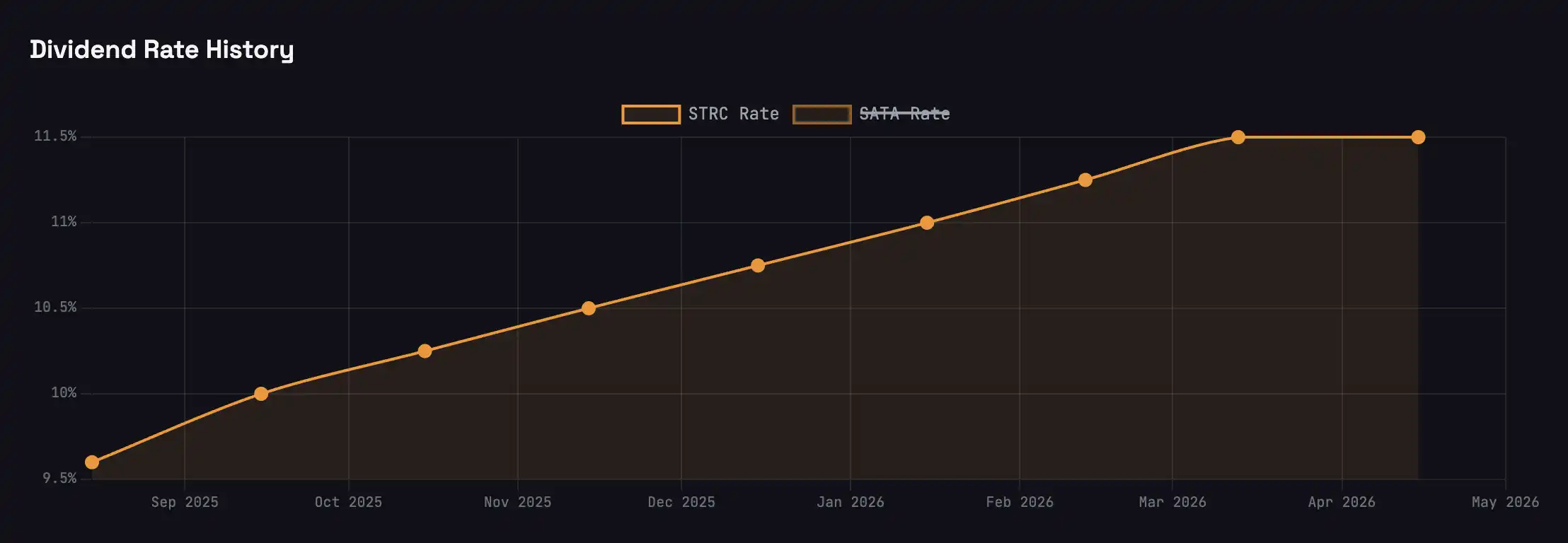
The stock price is anchored around the $100 face value through monthly dividend rate adjustments: if it falls below 100, the dividend rate increases to attract buyers; if it rises above 100, the dividend rate decreases to bring the price back towards the face value. The upper limit for the monthly dividend rate adjustment is 25 basis points.
Only when the STRC stock price is above $100 can Strategy issue new shares to raise funds at face value—this is the premise of the entire flywheel. After deducting the dividend reserve, the majority of the funds raised are used to purchase BTC.
Saylor has named this product "Short Duration High Yield Credit" or "Bitcoin-Backed Money Market Fund." In the current environment of around 3.5% U.S. Treasury yield, STRC offers a return equivalent to three times that of U.S. Treasuries.
Flywheel
One common misconception about Saylor is that he bought BTC by printing money out of thin air.
He couldn't do that. Saylor cannot just print money; he has to wait for the market to deliver the money to him. For every additional share of STRC issued, there must be a willing buyer at a price of $100.
The buyers of STRC are essentially engaging in a credit "transaction," where the 8% yield offered by STRC over Treasuries compensates for the "Strategy credit risk."
However, what many STRC buyers may not realize is that the funds used to purchase STRC indirectly flow into BTC, magnified threefold.
Strategy has a publicly stated financial goal: a 33% leverage ratio.
Of the total capital structure, perpetual preferred stocks like STRC, STRF, and STRK make up approximately one-third, with the remaining two-thirds coming from MSTR common stock. Saylor refers to this principle as "intelligent leverage." This means that whenever Strategy acquires $1 via STRC, in order to maintain the 33% leverage threshold, they must issue around $2 worth of MSTR to invest alongside in BTC. $1 in STRC + $2 in MSTR = $3 BTC buying pressure.
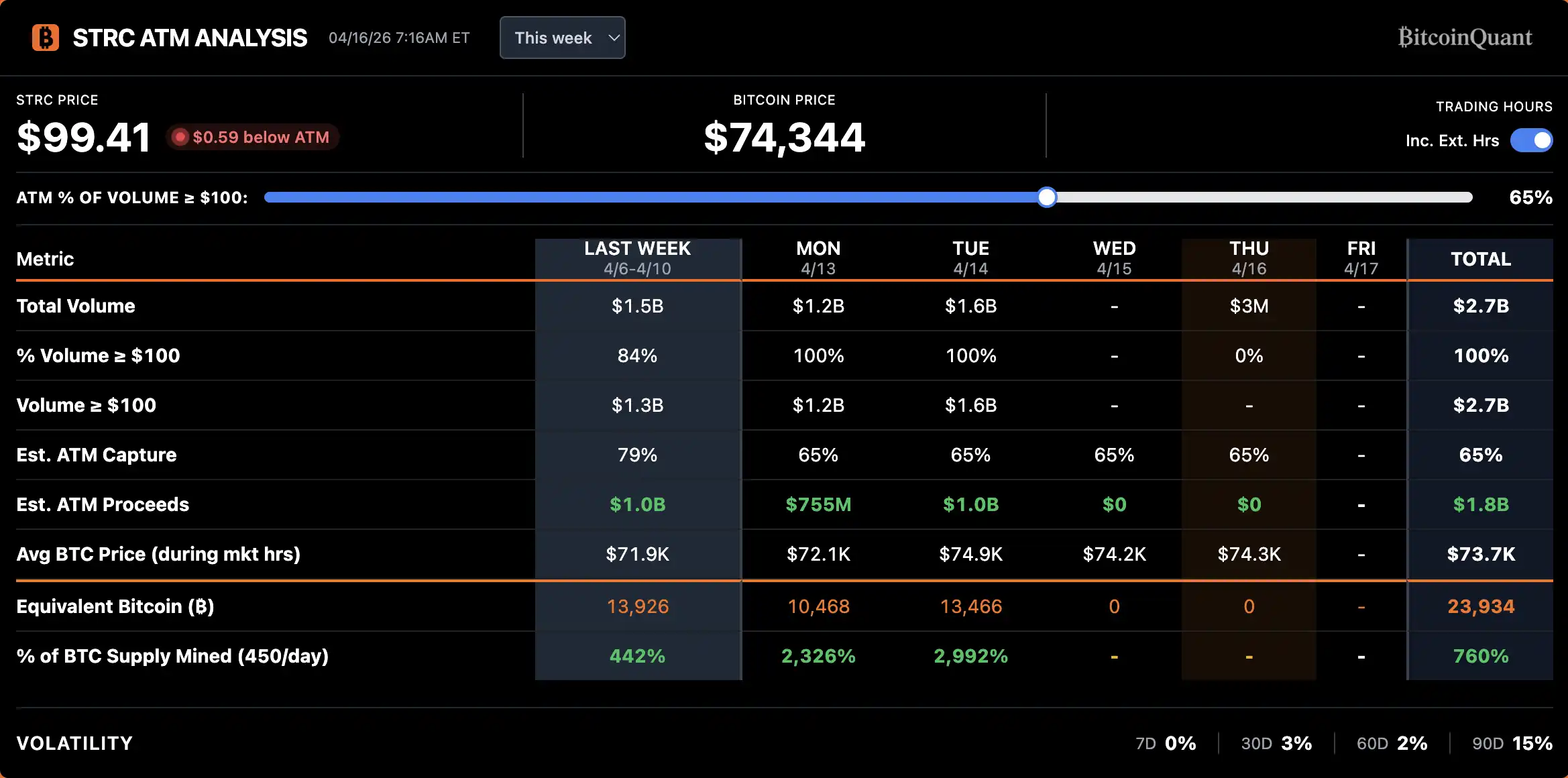
On April 14, through STRC, Strategy raised approximately $1 billion in a single day. Leveraged threefold, this corresponds to around $3 billion in BTC buy-side pressure, perfectly matching the scale of BTC accumulation in the first two weeks of April.
As BTC declines, collateral shrinks, STRC credit risk increases, and Strategy must increase the dividend rate to compensate for the new risk level. However, the higher the dividend rate, the greater the cash flow pressure and the higher the default probability. This creates an unstable feedback loop. During the time when BTC dropped from $120,000 to $60,000 last October, the STRC dividend rate had to be raised from 7% to 11.5% to barely recover the buy-side pressure.
Conversely, when BTC stabilizes and rises, collateral thickens, credit quality improves, and at the same dividend rate, STRC becomes more attractive, further expanding the demand. BlackRock's Preferred and Income Securities ETF in April listed Strategy's preferred shares as the second-largest holding, with the market value increasing from around $200 million in March to $344 million, providing direct endorsement from fixed income institutions of Strategy's current credit status.
The Strategy flywheel has turned positive: more funds buy STRC → Strategy leverages 3x to buy BTC → BTC price is supported → STRC collateral becomes more solid, credit spread tightens → Under the same dividend yield, STRC becomes more attractive → more funds buy STRC.
Ex-Dividend Day Arbitrage
Preferred shares have a dividend distribution mechanism different from bonds. Bonds accrue interest daily, where you earn interest for each day you hold the bond; preferred shares, on the other hand, pay out in a lump sum on fixed dates. For STRC, as long as you hold the stock by the close of the day before the ex-dividend day, you receive the full 96 cents monthly dividend.
This sets up an obvious arbitrage opportunity: rush in to buy a few days before the ex-dividend day, collect the dividend, and sell off the next day. Data from the past few months shows that STRC's average post-ex-dividend day drop is around 20 cents, much less than the 96 cents dividend itself. The net profit from a single ex-dividend arbitrage can reach around 40 to 50 cents per share.
Arbitrageurs will not miss out on this opportunity.
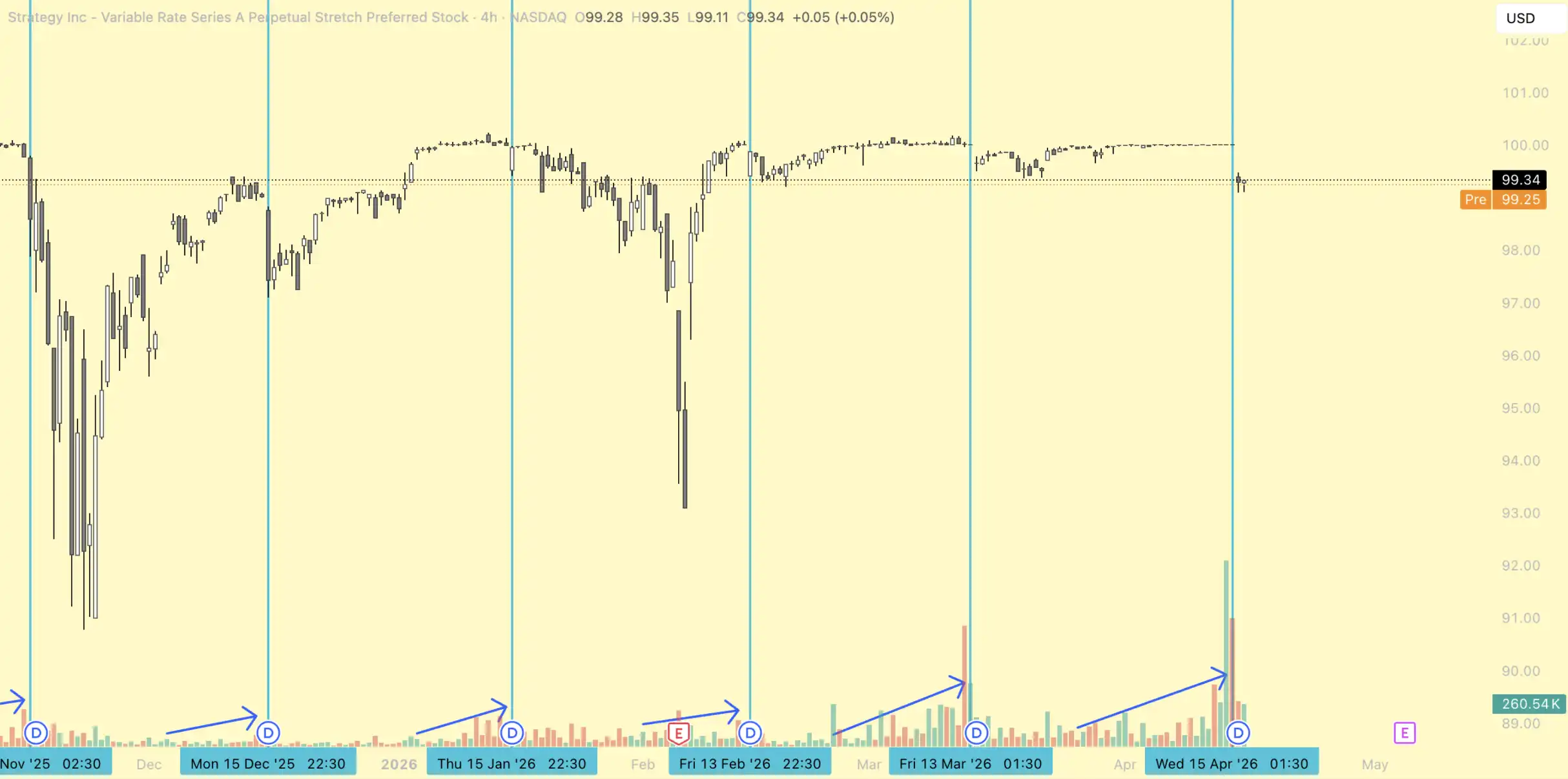
As shown in the chart, the trading volume starts to surge about a week before the ex-dividend day, peaks on or before that day, and quickly subsides after the ex-dividend day. The volume spike in April is significantly steeper than that of March, indicating an increasing number of funds participating in STRC ex-dividend arbitrage.
However, such arbitrage behavior may not be beneficial.
For the STRC product itself, the two to three weeks after the ex-dividend day enter a "dead zone" — liquidity shrinks, bid-ask spreads widen, and the stock price remains below the $100 face value for an extended period. This recurring anchoring failure will erode STRC's positioning as a "money market product," shifting it towards something more akin to a monthly fluctuation bond.
For Saylor, his BTC purchases are easily front-run by arbitrage funds. The STRC issuance is concentrated in the two weeks before the ex-dividend day, meaning his BTC purchases are also concentrated during this period.
Now, arbitrage traders swarm in to buy STRC at the same time each month. They know Saylor is about to use this money to sweep the BTC spot market, so they can buy BTC in advance, wait for Saylor to drive up the price, and then sell at a higher price, raising Saylor's buying cost.
In the recent two weeks, the Coinbase spot premium around the STRC ex-dividend day has significantly increased
There are two possible solutions: either change the dividend distribution frequency, such as shifting from monthly to bi-weekly and spreading out the arbitrage gains, or introduce a more elementary derivative product with more frequent dividends to decentralize the concentrated arbitrage trades.
Sure enough, Saylor took swift action and announced on Saturday that Strategy had submitted a proposal to change the dividend payment frequency of STRC from monthly to bi-monthly. The annual dividend payment obligation and yield remain unchanged.
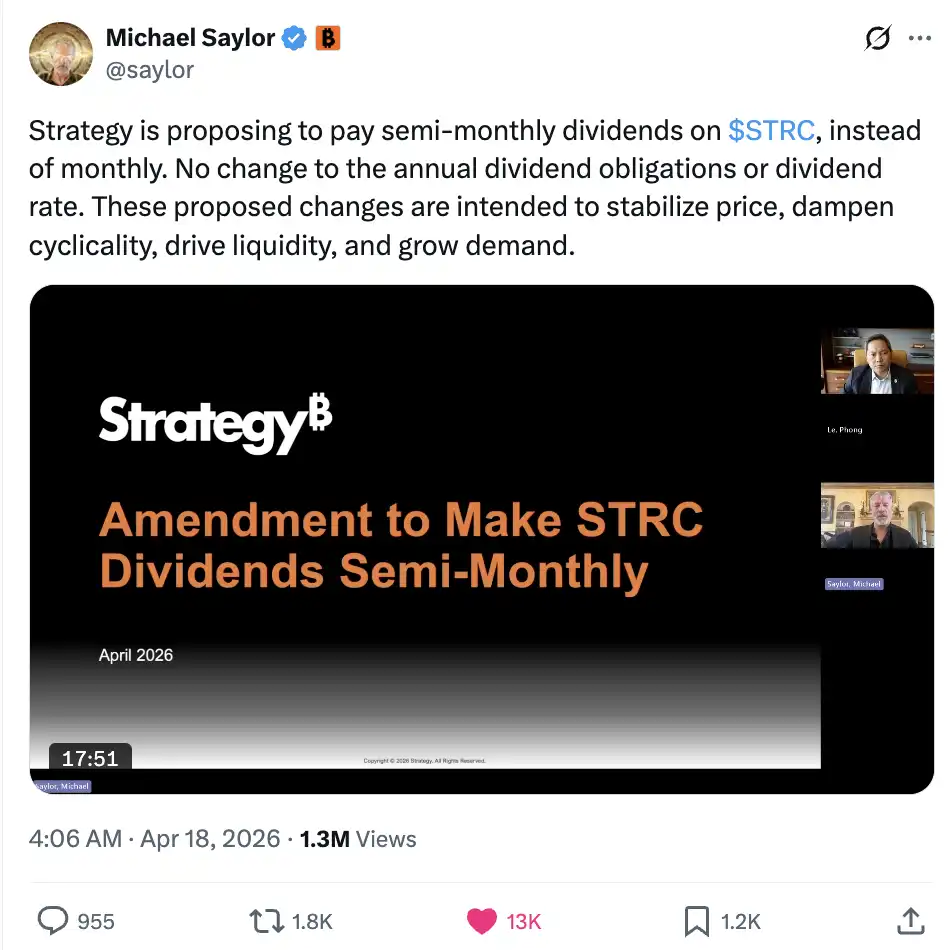
If the proposal is approved, the first bi-monthly dividend will be distributed on July 15.
Bitwise advisor Jeff Park pointed out that currently, there are no corporate bonds in the market using a bi-monthly dividend mechanism, and retail investors' preference for higher-frequency payments has been validated by the success of products such as weekly dividend ETFs.
On a deeper level, Jeff Park sees this as a significant step towards the penetration of the cryptocurrency industry's "streaming payment" vision into traditional capital markets. The frequency of interest payments fundamentally reflects the efficiency of transforming monetary potential energy into kinetic energy, and the digital currency era should break free from artificially imposed time cycle limits.
He believes that STRC has set a new benchmark for traditional enterprises and is excited about the future evolution towards bi-monthly, daily, and even instant payments.
The New Narrative of DeFi
The emergence of STRC has injected vitality into the lackluster DeFi market.
For the past year, DeFi stablecoin yields have been on a downward trend. The stablecoin deposits on Aave yield approximately 2% annually, while Ethena's USDe and Sky's USDS are below 4%, and even mainstream stablecoin PT on Pendle struggles to exceed 6%. This level of return corresponds to the risk exposure of AI-era smart contracts, and the risk-return ratio has deterred many DeFi veterans.
DeFi needs a trustworthy and sufficiently large source of income to pull TradFi's money back onto the chain, and STRC conveniently provides this opportunity.
Two projects are currently attempting to package STRC's yield on-chain:
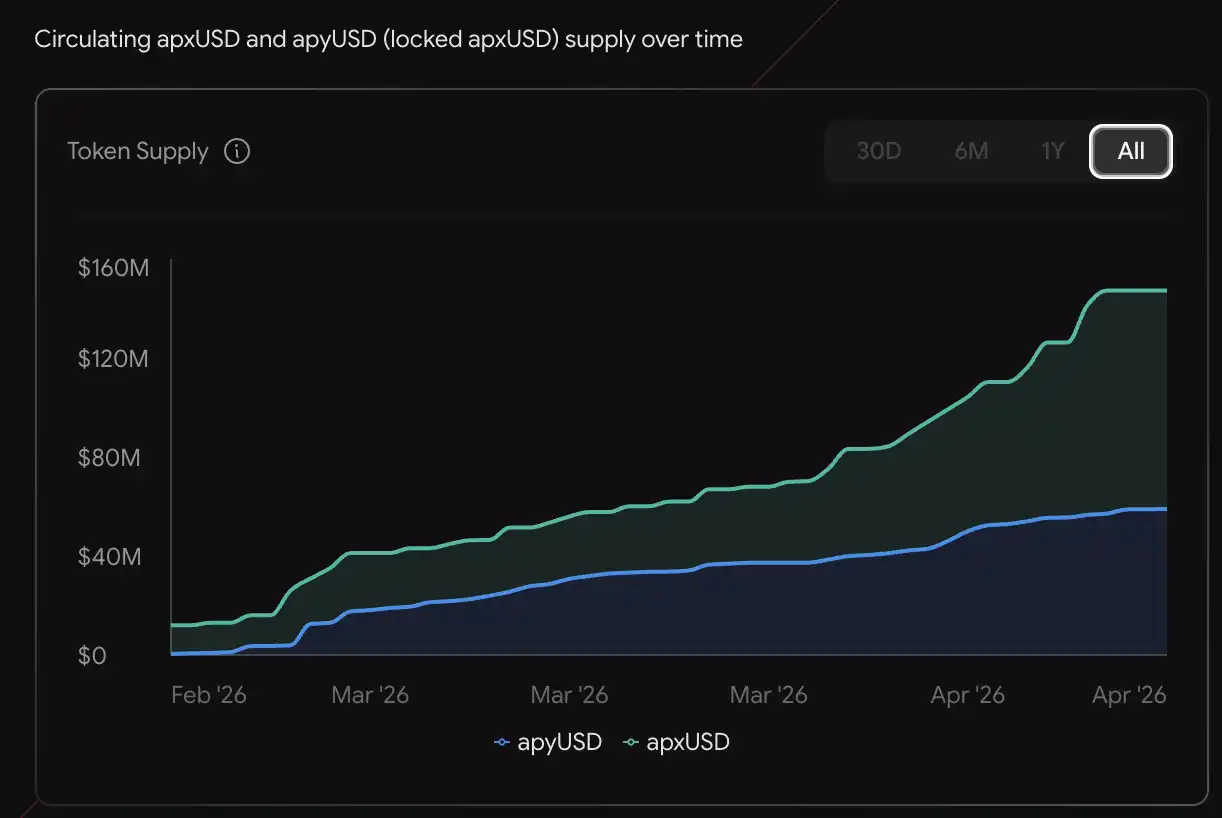
The Apyx Protocol adopts a dual-coin model. apxUSD is the base stablecoin backed by assets like STRC, SATA-like preferred stock, and excess collateral from U.S. Treasuries; apyUSD is the staking version that receives the underlying dividend and interest income, currently offering an annualized yield of about 12.78%. The supply has reached $130 million, with corresponding yield and leverage products on Pendle and Morpho.
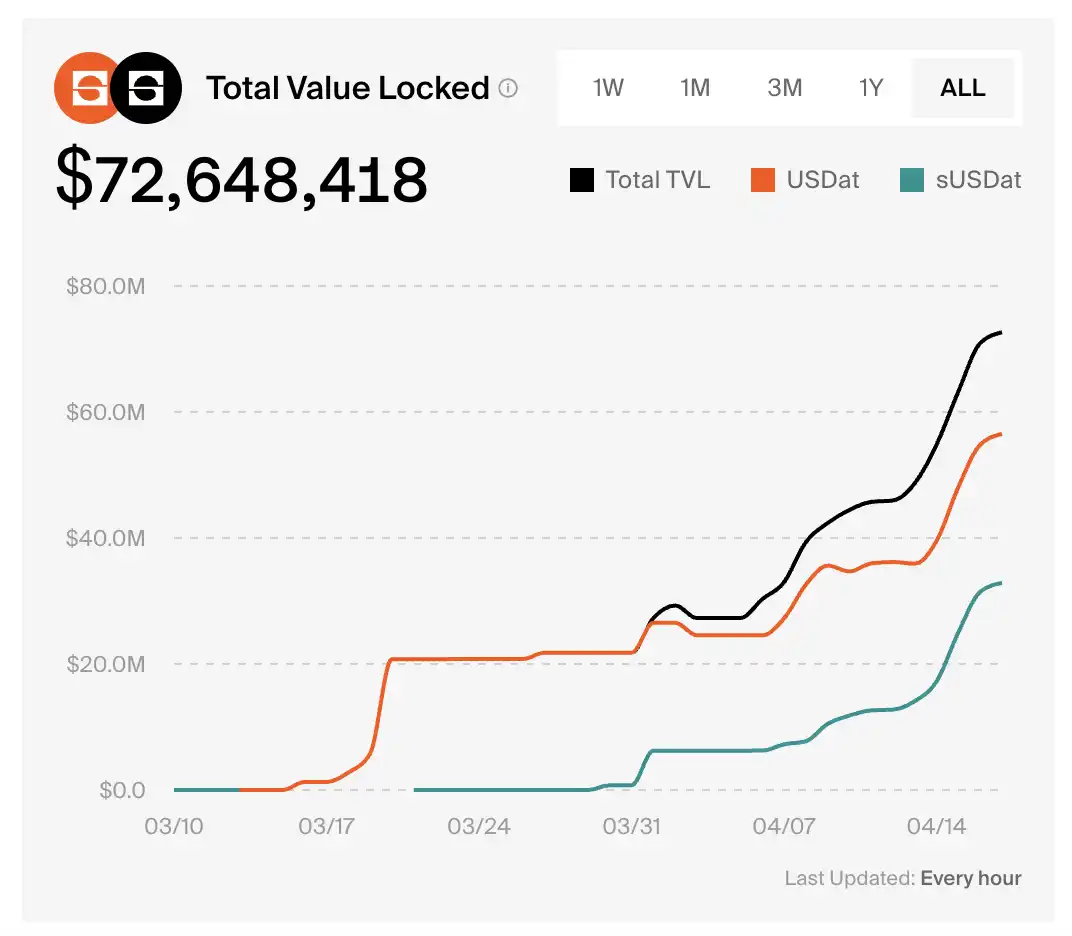
Saturn Credit's sUSDat is a yield-bearing stablecoin that mints STRC rewards, with the protocol's TVL surging from zero to $72.6 million in just over a month.
According to Pendle's market data, the current APY for PT-sUSDat is 9.2%.
The Die Is Cast
As Saylor's carefully crafted financial machine runs more successfully, one question becomes harder to avoid.
The amount of BTC in Strategy's possession now nears 3.5% of the total supply, with a continued pace of billions of dollars per month.
What was BTC's original value proposition? A currency asset that is decentralized, not controlled by any single entity, and resistant to unilateral manipulation by anyone.
When a publicly traded company's perpetual preferred stock becomes BTC—a currency asset that is decentralized, not controlled by any single entity, and resistant to unilateral manipulation by anyone—its primary source of marginal buying pressure, is Bitcoin deviating from its original form?
You may also like

New York Proposes Stricter Stablecoin Issuer Rules Aligned With Federal GENIUS Act
NYDFS proposed stricter stablecoin issuer rules aligned with the GENIUS Act, covering reserves, custody, redemption timelines, audits, and capital buffers.

Every exchange is a "Universal Exchange."

The counterattack of traditional finance: Alliance chains are quietly reviving

CryptoQuant Says Bitcoin Profitable Supply Is Near 45% Pressure Zone as On-Chain Data Points to Market Repricing
CryptoQuant said Bitcoin’s profitable supply is nearing the 45% pressure zone, signaling rising market stress, unrealized losses, and a possible on-chain repricing phase.

Bitcoin Falls Below 200-Week Moving Average as On-Chain Data Shows Over Half of Supply in Loss
Bitcoin dropped below its 200-week moving average as on-chain data showed over 50% of circulating supply is now in loss, signaling rising market stress.

CFTC Reportedly Plans New Prediction Market Rules Focused on Manipulation Risk and Public Interest Review
The CFTC is reportedly preparing new prediction market rules focused on manipulation risk, public interest review, and retail trader protections.

Meet the new WEEX trial fund—your gateway to greater profits

WEEX Labs Lands at Dutch Blockchain Week: A Disruptive Crypto × AI Conversation Sets Sail in Amsterdam

SK Hynix Reportedly Plans U.S. ADR Listing as Early as August, With SEC Approval Possible in Late June
SK Hynix may pursue a U.S. ADR listing as early as August, with SEC approval reportedly possible in late June amid strong AI chip supply chain demand.

SpaceX vs Tesla vs xAI: Which Elon Musk Trade Has the Biggest Upside in 2026?
OpenAI Reveals It Has Confidentially Submitted an S-1 to the SEC, Keeping the Door Open for a Future IPO
On June 9, according to an OpenAI announcement, the company recently confidentially submitted a draft S-1 registration statement to the U.S. Securities and Exchange Commission (SEC), beginning the preliminary compliance process for a potential initial public offering. OpenAI said it chose to disclose this proactively because it expected the news might leak; however, the company has not yet set a specific listing timeline, and related arrangements may still take some time.

Latest research from 13 top universities including Cornell University: The current state, challenges, and misconceptions of the fusion of Crypto and AI
Deconstructing Anthropic: The Best AI Company, Possibly Also a Type of Organizational Invention
Apollo and Blackstone Reportedly Back $35 Billion Anthropic Chip Financing as Deal Details Remain Unclear
On June 9, according to currently available news alerts, Apollo and Blackstone Group participated in a $35 billion financing for an Anthropic “chip project.” Based on the original wording of the report, the funding has already been raised, but public information remains limited. The financing structure, use of proceeds, project entity, and whether Apollo and Blackstone participated through equity, debt, or project financing have not yet been disclosed.

Humanity Protocol Security Incident Escalates: More Than $31 Million Stolen From Related Addresses as Attacker Continues Selling H for ETH
On June 9, according to monitoring by Onchain Lens, more than $31 million has been stolen from addresses linked to Humanity Protocol, and the attack is still ongoing, with the hacker continuously swapping H tokens for ETH. Project founder Terence Kwok later confirmed the security incident on X, saying the issue involved a private key leak.

Bloomberg: As Bitcoin Weakens, Stablecoins and RWA Continue to Drive Expansion in Crypto Businesses
In June, Bloomberg reported that despite Bitcoin falling below $60,000 last week, wiping out about $235 billion in market value within seven days, and dropping close to 50% from last year’s peak, some core businesses in the crypto industry are still expanding, mainly in stablecoins, real-world asset tokenization (RWA), payments, and infrastructure. The report also noted that overall altcoin activity has contracted significantly: altcoin market capitalization has fallen from a peak of about $431 billion in November 2021 to around $170 billion, and among the tens of millions of tokens issued in recent years, fewer than 1,700 still maintain meaningful trading activity.

Galaxy Deep Research Report: How Hyperliquid's HIP-4 Upgrade Changes the Landscape of Prediction Markets?
Binance Research: RWA Market Expected to Expand Nearly 6x from Early 2025, with Public Equities and Onchain Payments Heating Up Together
In June, Binance Research said in its monthly market report that the real-world asset (RWA) market is expected to grow by about 589% from the beginning of 2025. Bond- and money market fund-related RWA expanded by about $6.5 billion, up 83% year over year, while publicly traded equity RWAs grew by about 422%. The report also noted that monthly crypto debit card transaction volume exceeded $747 million in May, up 48.6% year to date.
New York Proposes Stricter Stablecoin Issuer Rules Aligned With Federal GENIUS Act
NYDFS proposed stricter stablecoin issuer rules aligned with the GENIUS Act, covering reserves, custody, redemption timelines, audits, and capital buffers.
Every exchange is a "Universal Exchange."
The counterattack of traditional finance: Alliance chains are quietly reviving
CryptoQuant Says Bitcoin Profitable Supply Is Near 45% Pressure Zone as On-Chain Data Points to Market Repricing
CryptoQuant said Bitcoin’s profitable supply is nearing the 45% pressure zone, signaling rising market stress, unrealized losses, and a possible on-chain repricing phase.
Bitcoin Falls Below 200-Week Moving Average as On-Chain Data Shows Over Half of Supply in Loss
Bitcoin dropped below its 200-week moving average as on-chain data showed over 50% of circulating supply is now in loss, signaling rising market stress.
CFTC Reportedly Plans New Prediction Market Rules Focused on Manipulation Risk and Public Interest Review
The CFTC is reportedly preparing new prediction market rules focused on manipulation risk, public interest review, and retail trader protections.


